1. Support Tripod
Provides an adjustable-height base and transfers the complete assembly load to the ground.
BIT-CCTV Pan-Tilt Support Systems
Build a portable remote pan-tilt station on a support tripod rated from 40 to 500 kg. BIT-CCTV offers four adjustable-height tripods for pan-tilt positioners, with customizable mounting plates for project-specific mechanical interfaces.
The capacities shown on this page are tripod ratings. Camera payload is determined separately by the motorized pan-tilt head, mounting geometry, and complete moving load.
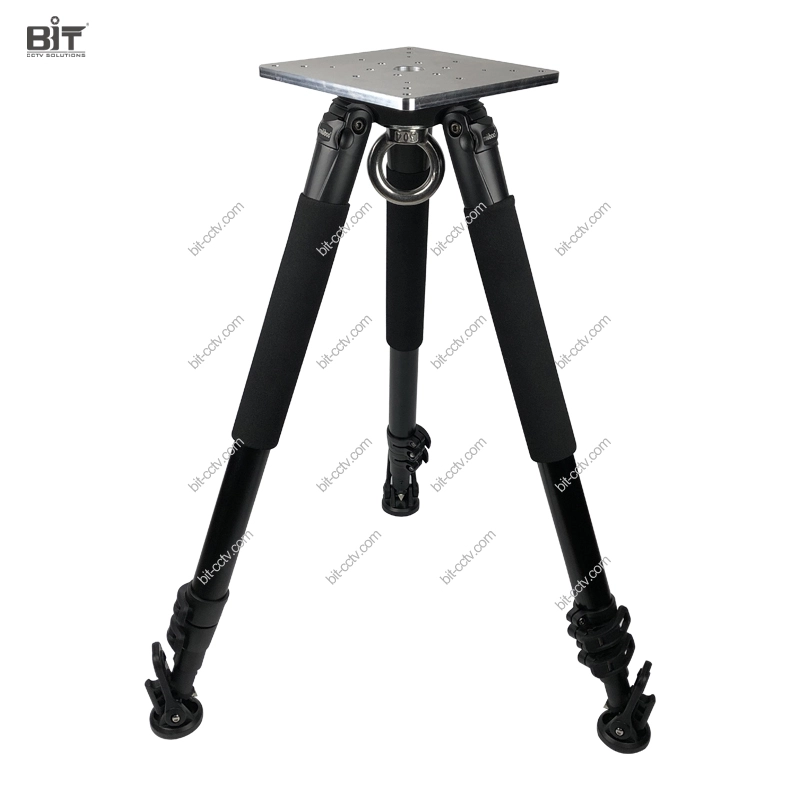
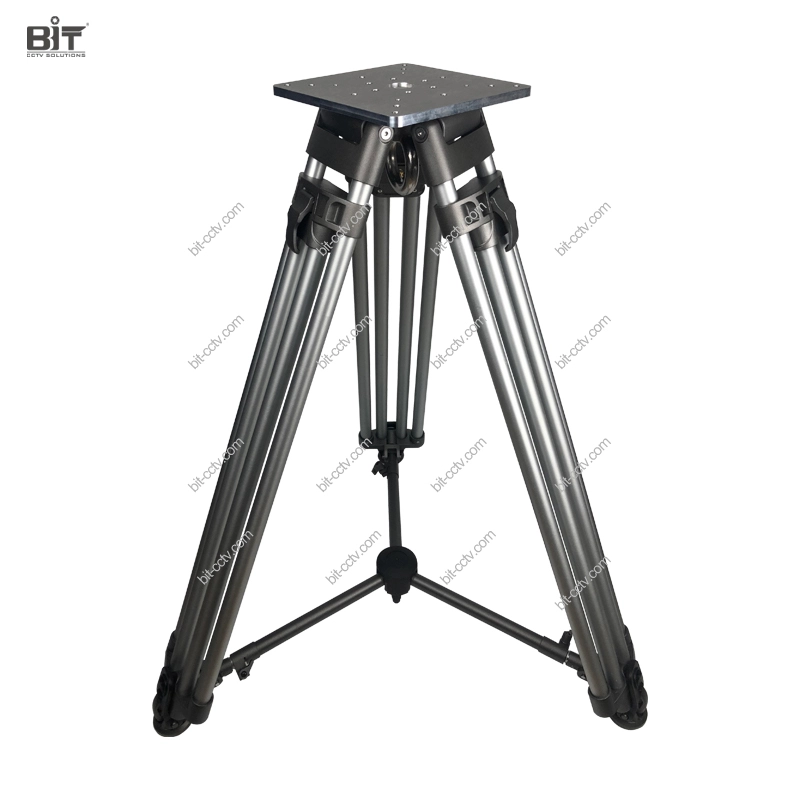
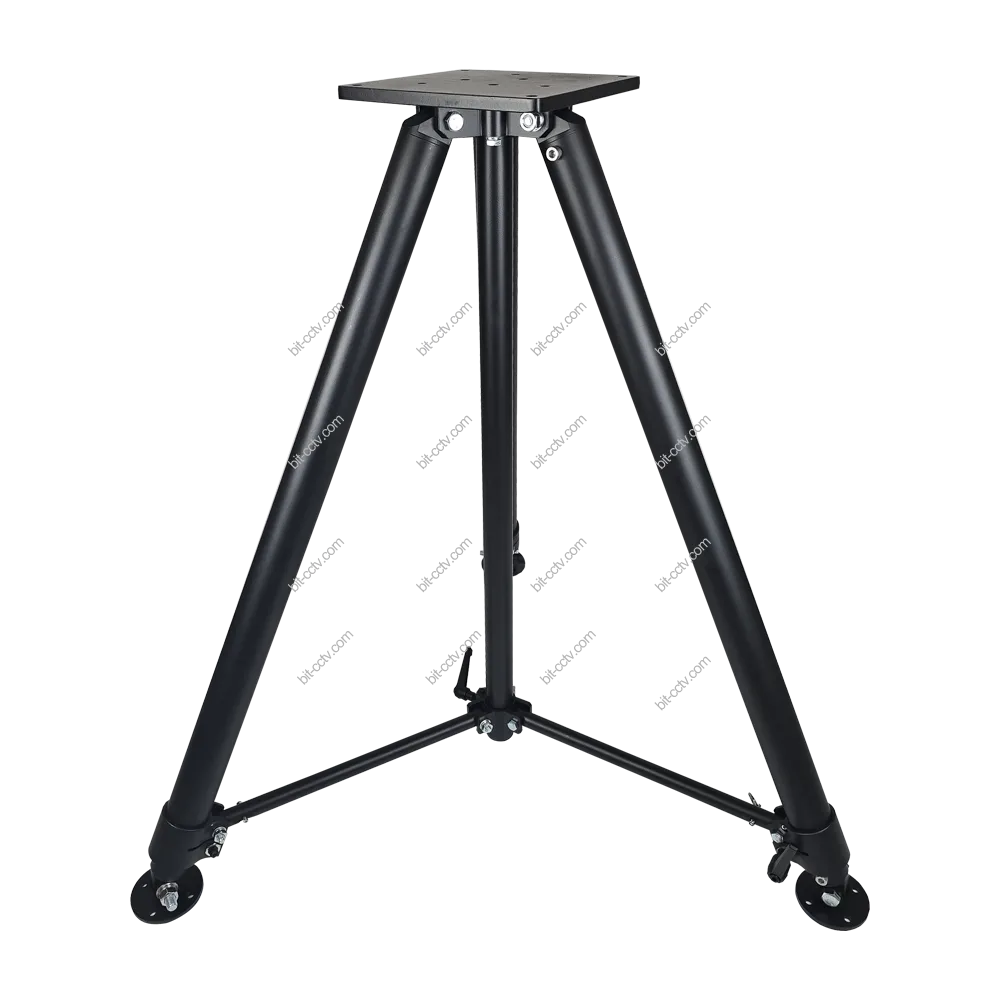
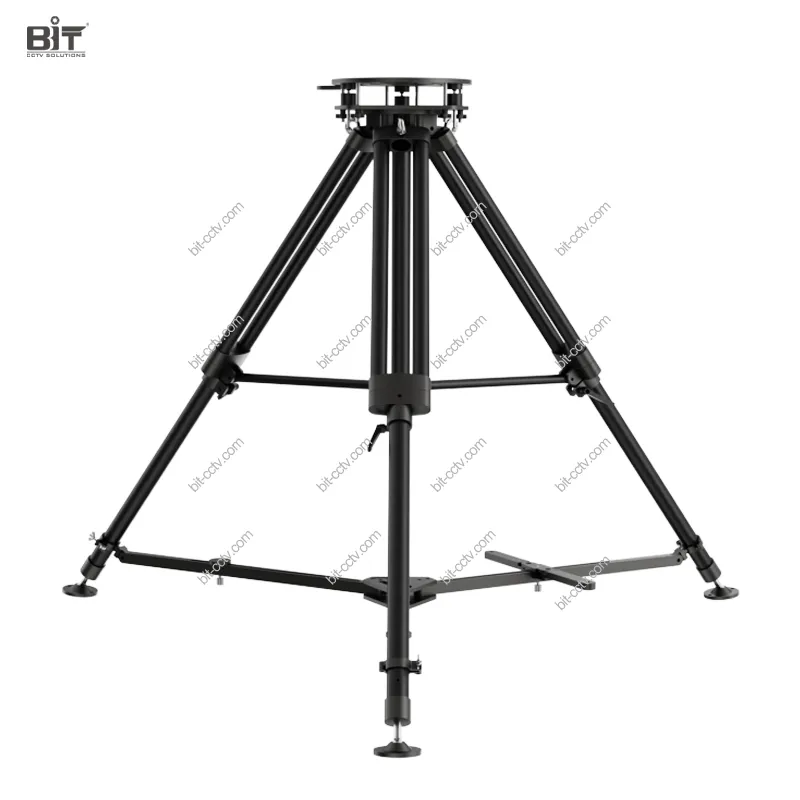
703A — 40 kg rated tripod capacity with a 320–1,640 mm height range. • 9116Y — 110 kg rated tripod capacity with an adjustable mounting plate. • 2010TS — 200 kg rated tripod capacity for heavier pan-tilt assemblies. • T500 — 500 kg rated tripod capacity with 48/40 mm structural tubes.
A motorized pan-tilt installation is a connected stack: the tripod supports the pan-tilt positioner, the positioner moves the camera or other payload, and mounting plates join the mechanical interfaces. The remote head also needs its own power and control path. Each layer has a separate rating and a separate job.
The 40–500 kg values on this page describe the support tripods. They do not state how much camera equipment a motorized head can move. The usable system limit comes from the lowest-rated applicable part, including the tripod, pan-tilt head, mounting plate, adapter, and fasteners.
Provides an adjustable-height base and transfers the complete assembly load to the ground.
Connects the tripod to the motorized head through the specified plate, hole pattern, fasteners, and anti-rotation features.
Creates horizontal and vertical motion. Its own load, torque, speed, angle, power, and control limits govern movement.
Includes the camera, lens, housing, brackets, illuminators, connectors, and moving cable sections carried by the head.
Start with the total supported assembly: motorized head, camera or sensor package, mounting plates, adapters, fasteners, and any equipment that rests on the tripod. Then compare the required working height and the top mounting interface. A taller setup or an offset center of gravity can reduce stability even when the total mass stays below the tripod’s headline capacity.
| Model | Rated tripod capacity | Height range | Tripod weight | Material |
|---|---|---|---|---|
| 703A | 40 kg / 88.2 lb | 320–1,640 mm / 12.6–64.6 in | 6.5 kg / 14.3 lb | Aluminum alloy |
| 9116Y | 110 kg / 242.5 lb | 760–1,480 mm / 29.9–58.3 in | Up to 11.5 kg / 25.4 lb | Aluminum alloy |
| 2010TS | 200 kg / 440.9 lb | 860–1,520 mm / 33.9–59.8 in | 15 kg / 33.1 lb | Aluminum alloy structure |
| T500 | 500 kg / 1,100 lb | 870–1,450 mm / 34.3–57.1 in | Up to 30 kg / 66.1 lb | Aluminum alloy and stainless steel |
The 703A covers the widest published height range and the lowest minimum setup height. The 9116Y and 2010TS raise the tripod capacity for heavier assemblies. The T500 provides the highest published tripod capacity and uses aluminum alloy with stainless steel in its structure. Final selection also depends on the mounting plate, ground conditions, center of gravity, wind or other external forces, and the limits of the motorized head.
View all four tripod modelsCompare the complete published specifications for the four designated BIT-CCTV support tripods. Use the product detail links for model pages, or send the complete system configuration for a mounting review.
Adjustable 703A tripod with ground-mounting foot brackets and included carry bag.
The 703A is a portable aluminum-alloy support tripod for light-duty BIT-CCTV pan-tilt positioners. Three buckle-lock height settings provide a working range from 320 to 1,640 mm, while foot brackets allow the legs to be secured to the ground. The standard application covers BIT-PT503, BIT-PT410, and BIT-PT510; a customized top plate and installation holes can support other devices after interface review.
9116Y heavy-duty tripod with adjustable height, ground-mounting foot brackets, and customizable mounting plate.
The 9116Y supports pan-tilt assemblies up to its 110 kg tripod rating. Its aluminum-alloy structure adjusts from 760 to 1,480 mm, folds to a published transport length of 950 mm, and includes a carry bag. The mounting plate can be customized to the required pan-tilt interface.
2010TS heavy-duty tripod for higher-capacity pan-tilt support, with adjustable height and a customizable mounting plate.
The 2010TS provides a 200 kg rated tripod capacity for heavier pan-tilt assemblies. Its aluminum-alloy structure adjusts from 860 to 1,520 mm, and its 980 mm transport length supports relocation between deployment points. Ground-mounting foot brackets and a customizable mounting plate support project-specific installation planning.
T500 heavy-load tripod with aluminum-alloy and stainless-steel construction and 48/40 mm tubes.
The T500 is the highest-capacity support tripod in this selection, with a published rating of 500 kg / 1,100 lb. Its aluminum-alloy and stainless-steel structure uses 48/40 mm diameter tubes with 4 mm tube thickness. The working height adjusts from 870 to 1,450 mm, and the mounting plate can be customized for the pan-tilt assembly.
A secure assembly depends on every connection from the tripod top plate to the moving payload. Confirm the tripod top plate and pan-tilt base first, including the hole pattern, hole diameter or thread, engagement length, locating surfaces, fasteners, and anti-rotation features. BIT-CCTV can customize mounting plates for the specified equipment interface.
Continue the mechanical check above the motorized head. The head-to-payload plate must fit the equipment interface, retain the load against rotation, and leave clearance through the full pan-and-tilt envelope. Customized tripod top plates solve a defined hole-pattern or mounting-surface mismatch; they do not change the rated capacity of the tripod or motorized head.
Project Inquiry
Blue Icon (Tianjin) Technology Co., Ltd. manufactures products under the BIT-CCTV brand. In the Requirement field, include the pan-tilt head model, complete supported mass, center-of-gravity position, required height range, mounting interface, ground conditions, wind or vibration exposure, and transport needs. When the mounting plate needs to be customized, email the base drawing to [email protected] or enter the measured hole-pattern dimensions in the Requirement field.