Continuous azimuth coverage
Continuous 360° pan supports repeated sweeps across a perimeter without a fixed azimuth endpoint interrupting the route.
BIT-CCTV Industrial Positioning Systems
Position camera housings, long-range lenses, sensors, antennas, and other outdoor payloads weighing up to 100 kg (220 lb). BIT-CCTV heavy duty heads combine variable-speed pan and tilt motion, ±0.1° preset accuracy, position feedback, and IP66 protection for fixed and portable observation systems.
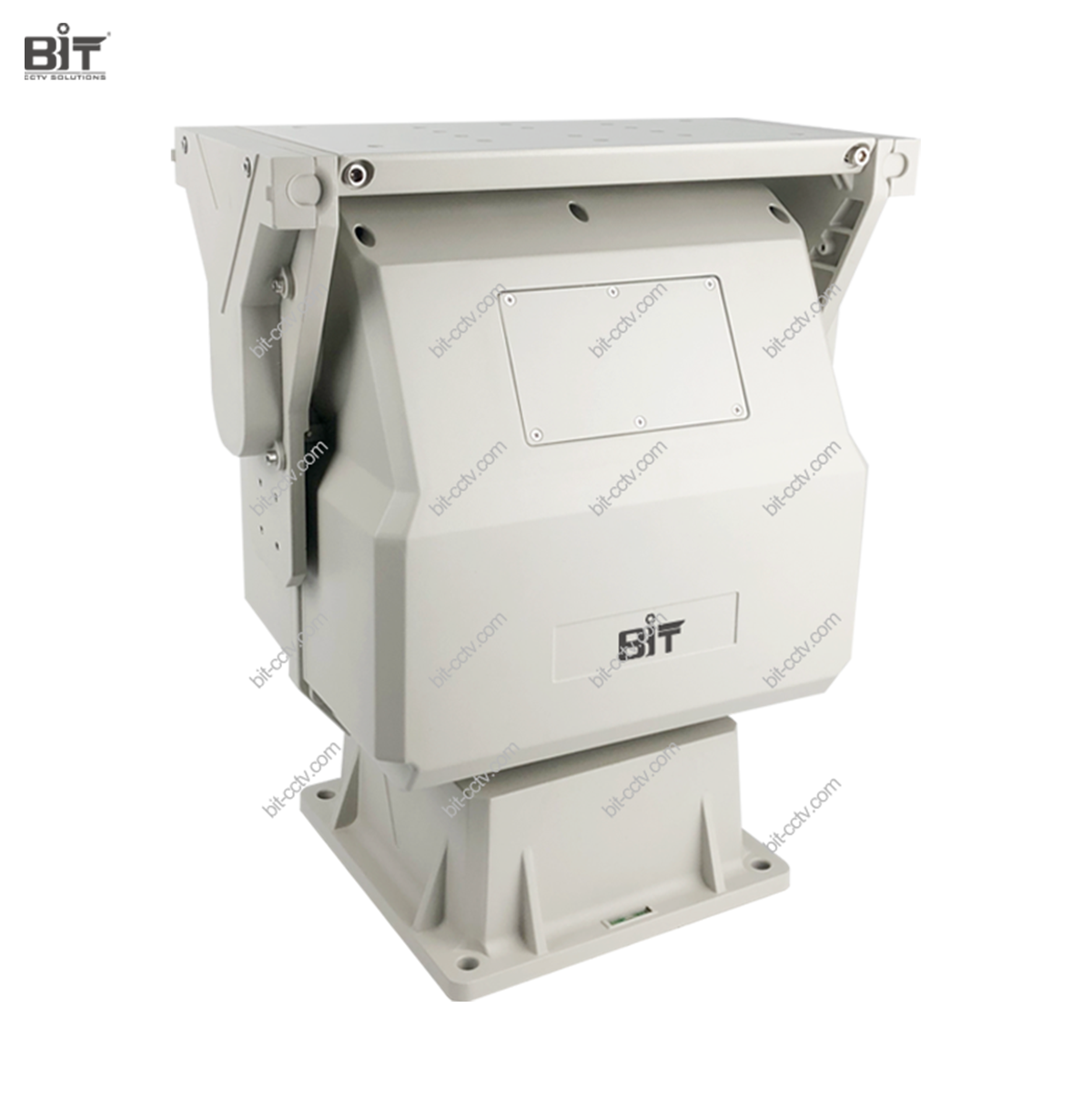
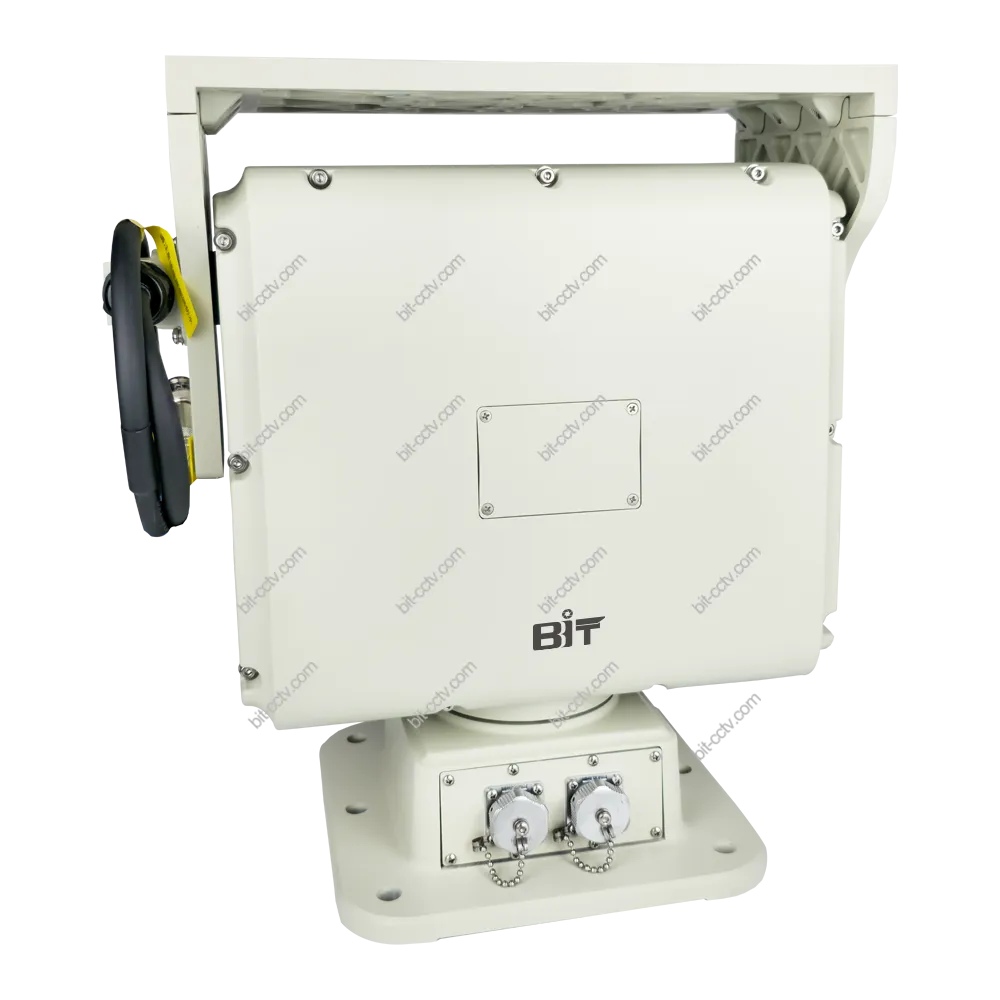
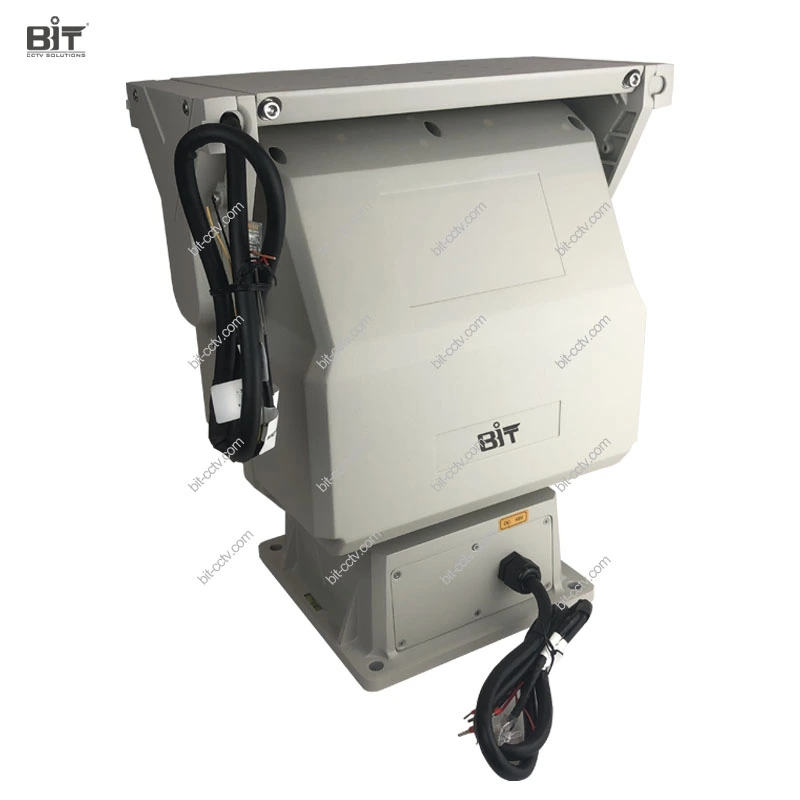
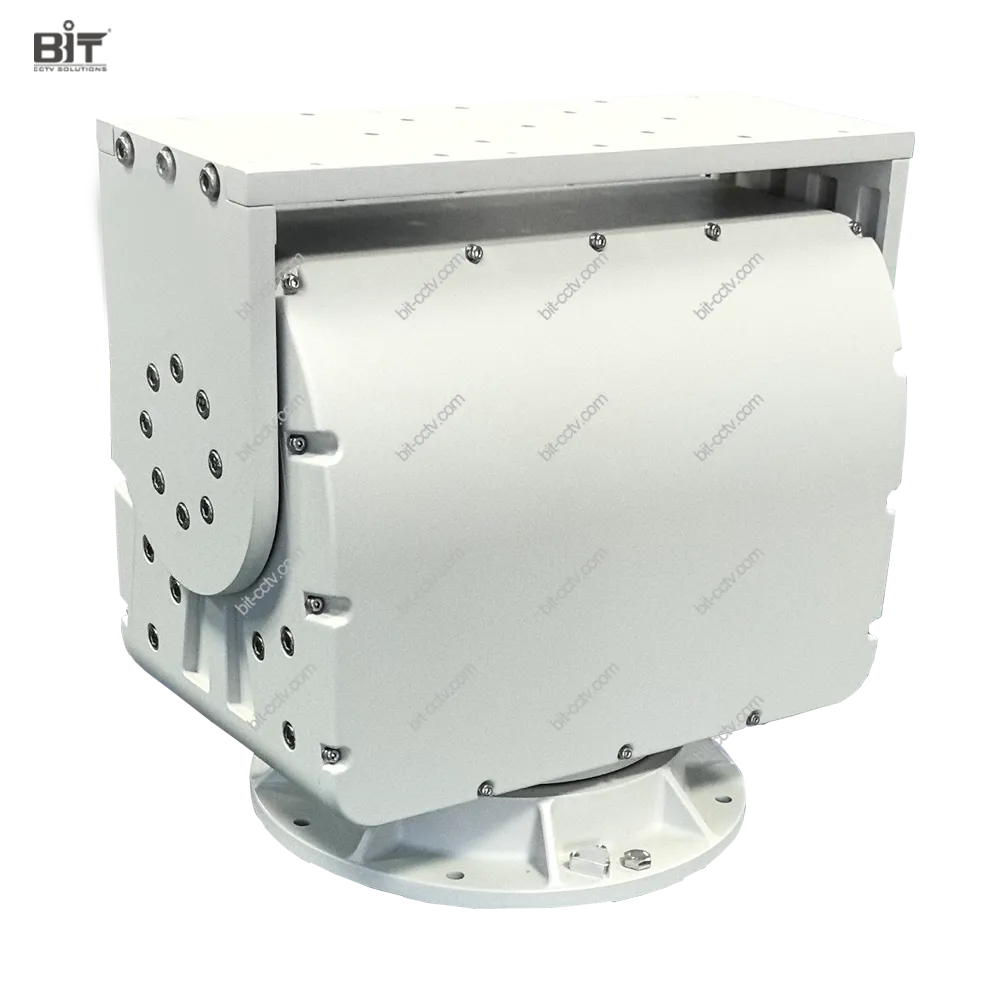
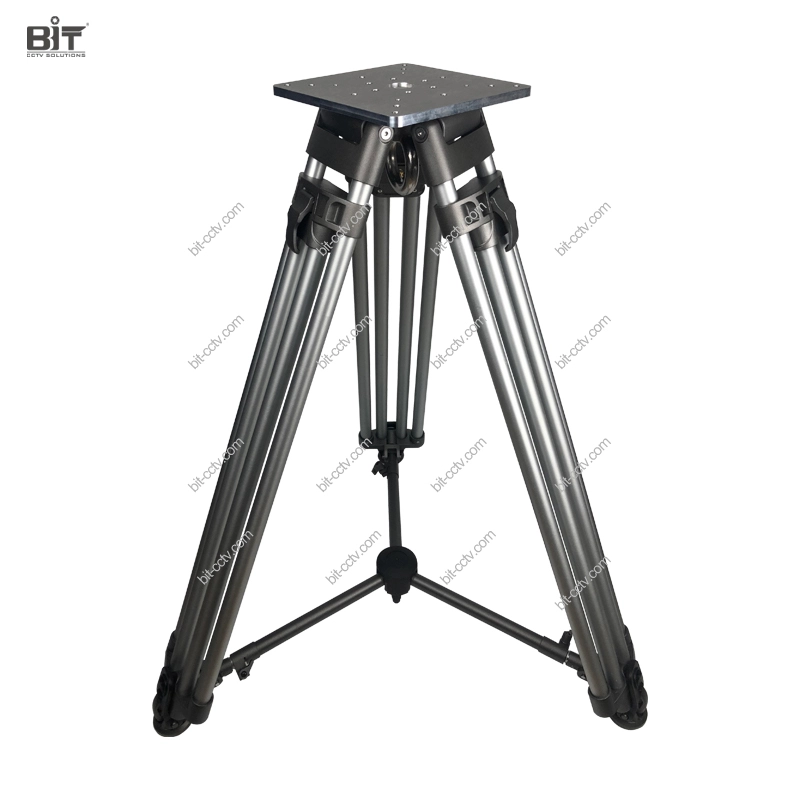
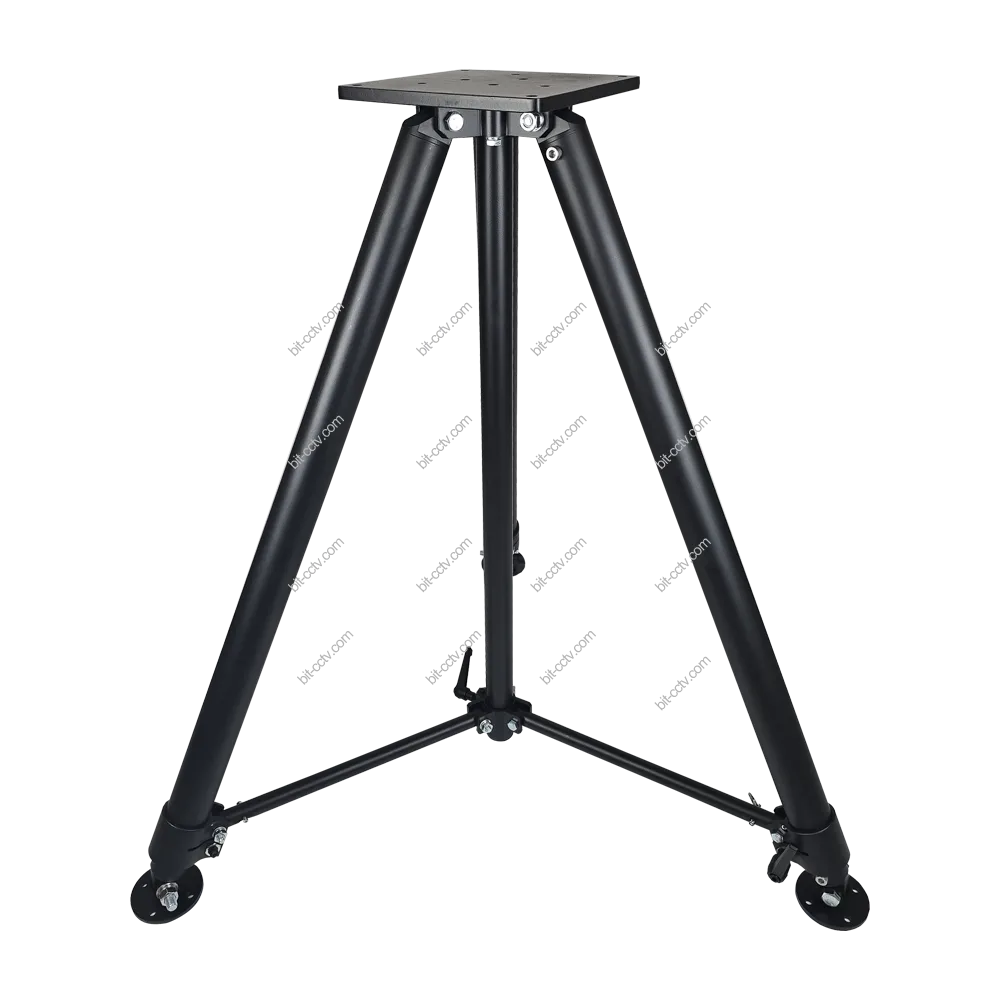
Four outdoor motorized positioners and two adjustable support tripods for heavy observation systems.
Industrial range
These two-axis positioners rotate an installed payload in azimuth and elevation. They are sized for industrial observation equipment rather than lightweight camera-motion rigs: the moving load may include a camera, long-range lens, protective housing, illuminator, sensor, antenna, mounting plate, connectors, and the cable section carried by the head.
All four heads provide continuous 360° pan, variable-speed movement, ±0.1° preset accuracy, position feedback, Pelco P/D control, and IP66 ingress protection. Their differences matter at the system level. Each payload level has its own speed profile, while the available tilt envelope can narrow as load rises.
| Model | Maximum stated load | Pan range and speed | Tilt range and speed at maximum stated load | Input power |
|---|---|---|---|---|
| BIT-PT850 | 50 kg (110.23 lb), top load | Continuous 360°; 0.01–30°/s | −45° to +45°; 0.01–15°/s | 24 VAC or 24 VDC |
| BIT-PT865 | 65 kg (143 lb), top or side mount | Continuous 360°; 0.01–20°/s | −45° to +45°; 0.01–10°/s | 48 VDC |
| BIT-PT890 | 90 kg (198.42 lb), top load | Continuous 360°; 0.005–15°/s | −45° to +45°; 0.005–7°/s | 48 VDC |
| BIT-PT8100 | 100 kg (220 lb), top or side mount | Continuous 360°; 0.01–20°/s | −70° to +70°; 0.01–5°/s | 48 VDC |
The BIT-PT850 offers the fastest tilt speed in this group and can expand its tilt range when the load is reduced: 40 kg permits −60° to +60°, and 26 kg permits −80° to +80°. The BIT-PT890 reaches the lowest minimum speed at 0.005°/s, which supports fine corrections at long focal lengths. The BIT-PT8100 carries the largest listed payload and provides the widest stated tilt range at its maximum listed load.
View All Six ProductsMotion performance
A precision stepper motor drives each axis through a worm-and-gear transmission. The reduction mechanism converts motor motion into controlled movement of a large payload, and the self-locking function helps the head hold its position when drive power is removed. On BIT-PT850, BIT-PT890, and BIT-PT8100, power-failure memory can restore the prior position or programmed movement after power returns.
Low minimum speed matters when a narrow field of view magnifies every angular change. BIT-PT850 and BIT-PT865 start at 0.01°/s; BIT-PT890 starts at 0.005°/s. These low rates let an operator make smaller visual corrections without sweeping a distant target out of frame. Maximum speed serves a different purpose: it determines how quickly the head can move between sectors or presets.
Preset accuracy of ±0.1° describes how closely the head returns to a commanded preset position. Position query or real-time feedback lets the control system read the current angle, while absolute-position commands let a compatible controller request a specific coordinate. Those functions support repeatable sector checks, programmed scans, and return-to-view workflows, but they do not replace optical stabilization or compensate for a flexible pole, tripod, or foundation.
Continuous 360° pan supports repeated sweeps across a perimeter without a fixed azimuth endpoint interrupting the route.
Presets, cruise tracks, scans, and guard positions allow routine observation paths to run through a compatible controller. BIT-PT850, BIT-PT890, and BIT-PT8100 also list power-failure memory.
Worm-and-gear transmission and self-locking behavior help resist back-driving, so a balanced payload can remain directed at the selected sector between movements.
Product range
Choose the pan tilt head from the moving payload and motion requirements, then size the support beneath it for the combined head, payload, mounting hardware, and environmental forces. The two tripods below are support products; they do not provide motorized pan or tilt motion.
BIT-PT850 outdoor positioner for payloads up to 50 kg.
A 24 V outdoor top-load positioner for long-range camera and sensor assemblies. Its 30°/s pan and 15°/s tilt maxima provide the fastest full-load motion in this four-model group, while its load-dependent tilt options let a lighter assembly reach farther above and below the horizon.
BIT-PT865 outdoor positioner for payloads up to 65 kg.
A 48 VDC positioner that supports top or side mounting. At its 65 kg rating it combines 20°/s pan, 10°/s tilt, coordinate feedback, and a 4000 V lightning-surge protection feature for outdoor surveillance and communication systems.
BIT-PT890 outdoor positioner for payloads up to 90 kg.
A 48 VDC top-load head for large long-range observation assemblies. Its 0.005°/s minimum motion supports fine angular adjustment, while double-pitch worm gearing, an anti-loose design, sealed key components, corrosion-resistant treatment, and IP66 construction address exposed sites.
BIT-PT8100 outdoor positioner for payloads up to 100 kg.
The highest-capacity head in this group supports top or side mounting and a −70° to +70° tilt range. Its 48 VDC drive, 200 W maximum power consumption, position feedback, and 50 kg head weight suit engineered installations with a rigid support and planned lifting access.
9116Y adjustable tripod rated for loads up to 110 kg.
A portable aluminum-alloy tripod for temporary or relocatable pan tilt installations. Its adjustable height and included carry bag support field deployment, while foot brackets provide points for securing the legs to the ground.
2010TS adjustable tripod rated for loads up to 200 kg.
A higher-capacity portable tripod with an aluminum-alloy structure and adjustable height. The 200 kg rating provides additional support capacity for a heavy pan tilt head and payload, subject to the complete system’s center of gravity, mounting interface, ground anchoring, and environmental loads.
Selection method
Payload mass sets the first boundary, but it does not describe the turning demand on the axes. A long housing or offset instrument can create a larger moment than a compact payload of the same weight. Use the complete moving assembly and its installed geometry to compare models.
Add the camera, lens, housing, sensor, illuminator, antenna, mounting plate, connectors, and every cable or hose section that moves with the head. Record the total mass, overall envelope, mounting orientation, and center of gravity relative to both axes.
Calculate the static moment from weight and offset, then account for rotational inertia, acceleration, braking, start-stop frequency, cable drag, and the intended duty cycle. Outdoor systems also add wind, vibration, platform motion, and possible impact loads. These forces determine whether a nominal kilogram rating remains suitable in the installed configuration.
Specify pan and tilt limits, minimum tracking speed, normal operating speed, maximum repositioning speed, stopping time, preset accuracy, and feedback needs. Maximum payload and maximum speed should be evaluated together under the real load; a catalog maximum in one column does not establish that every maximum can occur at once.
Size the pole, pedestal, bracket, tripod, fasteners, and foundation for the combined head and payload, including their center of gravity and dynamic reactions. Confirm hole patterns, contact surfaces, stiffness, corrosion protection, cable routing, maintenance access, and clearance through the entire motion envelope.
BIT-PT850 is the starting point for loads at or below 50 kg when 24 V power or faster full-load motion is useful. BIT-PT865 adds top/side mounting and a 65 kg rating. BIT-PT890 serves heavier 90 kg top loads and provides the lowest listed speed for fine long-range movement. BIT-PT8100 reaches 100 kg and the widest full-load tilt range in this group. Final selection requires the payload drawing, center of gravity, motion profile, and site conditions because allowable moment and inertia limits are not stated in the available model data.
Send Your Load DetailsSystem integration
The control chain starts with a compatible keyboard, software, VMS, or host controller and ends at the pan tilt drive. RS485 is standard across the four heads, Pelco P/D commands provide movement control, and supported baud rates span 2400 to 19200 bps. Optional interfaces vary by model, so matching the connector alone does not establish command or feedback compatibility.
Position feedback also differs by configuration. The BIT-PT850 and BIT-PT890 support angle-query feedback with real-time feedback options, BIT-PT865 offers RS485 query feedback and optional RS422 real-time feedback, and BIT-PT8100 lists RS422 position query/feedback. The host must parse the model’s actual feedback format and command set if it needs coordinate display or absolute positioning.
Power changes across the range. BIT-PT850 accepts 24 VAC or 24 VDC and consumes up to 100 W. BIT-PT865 and BIT-PT890 require 48 VDC and consume up to 150 W; BIT-PT8100 requires 48 VDC and consumes up to 200 W. Size the supply, conductors, protection, grounding, and voltage drop for the selected head and the equipment powered at the rotating top.
| Interface decision | Project information to match |
|---|---|
| Movement commands | Pelco P or D implementation, device address, baud rate, supported commands, and controller behavior |
| Position data | Query or real-time mode, physical interface, coordinate format, update rate, and host software support |
| Pass-through signals | Ethernet, serial control, video, RF, sensor data, and any other circuits that must cross the rotating joint |
| Top-side power | Required voltage, peak current, connector, grounding, and simultaneous accessory load |
| Startup behavior | Calibration movements, zero position, clearances, cable slack, and recovery after power loss |
A bench test should exercise direction, variable speed, stop commands, presets, coordinate feedback, power interruption, reconnection, and full travel with the intended controller. This reveals protocol and cabling differences before the assembly is installed at height or in a remote location.
Site engineering
IP66 construction protects the listed heads against dust ingress and powerful water jets, while their aluminum-alloy bodies and surface treatments support outdoor service. Site design must still address temperature, condensation, drainage, salt or chemical exposure, lightning environment, cable-entry sealing, and the environmental ratings of every connector, power supply, enclosure, and attached device.
Mount stiffness directly affects long-range image stability and preset performance. A flexible pole, loose adapter, uneven base, or lightly anchored tripod can move even when the head reaches the commanded angle. The foundation and support should resist the combined dead load, offset moment, acceleration and braking reactions, and wind load on the entire exposed assembly.
Keep cables clear through full pan and tilt travel, with enough controlled slack for movement and strain relief at both ends. BIT-PT865 performs calibration movements at startup, so its external cables need a route that tolerates that motion without twisting, pulling connectors, or entering a pinch point.
The 9116Y and 2010TS support portable deployments where a permanent pedestal is unavailable. Their vertical load ratings do not by themselves establish stability with a tall, offset, or wind-exposed payload. Set the legs on a firm surface, use the provided foot brackets or an engineered restraint method, keep the assembly within the verified center-of-gravity envelope, and confirm the top plate and fasteners match the pan tilt base.
Application fit
Slow variable-speed movement helps keep a narrow camera view controllable, while presets and coordinate feedback support repeated checks of distant sectors. The payload rating accommodates long lenses, outdoor housings, illuminators, and related equipment when their combined mass and moment remain within the engineered limits.
Continuous 360° pan supports broad sector sweeps, and programmed scans or cruise tracks can revisit defined directions. At a gate, runway edge, harbor entrance, or perimeter intersection, preset positions let an operator move directly between priority views instead of searching for each view manually.
IP66 construction and wide operating-temperature ranges support exposed observation points used to watch forest sectors, river approaches, shorelines, and critical equipment.
Absolute-position commands and angle feedback can direct compatible non-camera payloads to known coordinates. Integration depends on the payload’s center of gravity, cable or RF path, required pointing behavior, control protocol, and the electrical channels that must pass through the rotating assembly.
Project inquiry
Send the complete payload weight, dimensions, center-of-gravity location, mounting orientation, required pan/tilt range and speed, control interface, power source, and site conditions. Blue Icon (Tianjin) Technology Co., Ltd. will use those details to discuss a suitable BIT-CCTV model and the mechanical and electrical interfaces your system needs.