Pan is talking about the horizontal rotation of the camera along the vertical axis, and Tilt is talking about the pitch rotation along the horizontal axis. Putting these two motion axes into the same positioning mechanism is what is often called a two-dimensional gimbal. A camera with a pan-tilt in its name could be an integrated model with a horizontal pitch mechanism integrated into the fuselage, or it could be a combination of a fixed camera mounted on an external two-dimensional gimbal. Both seem to be capable of rotation, but the structure, power supply and control methods are quite different. When choosing, you must first see which one you are facing.
What 1080p Resolution Really Does
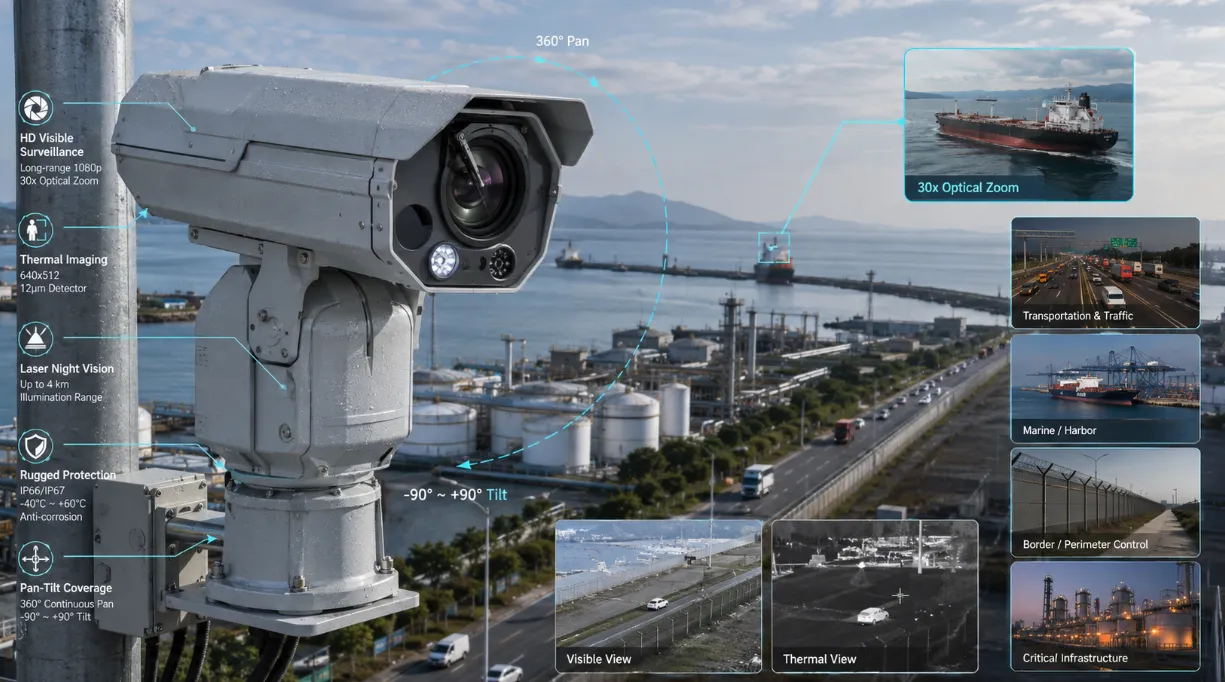
The word resolution has two meanings in a camera: one is the image clarity, and the other is the minimum position increment that the gimbal can instruct or detect. Don't confuse the two. For products like the 1080p pan tilt camera, 1080p points to the former, which is the high definition of the picture. Its relationship with zoom is the most easily overlooked. Optical zoom adjusts the field of view and image size by changing the lens focal length, and details are captured in real footage; digital zoom simply cuts and enlarges the existing image. The amount of magnification you can achieve will be limited by the source image and output resolution. The higher the resolution, the more pixels can be cropped for the same digital magnification. Lossless magnification is only true when the number of pixels required for output does not exceed the number of pixels that can be provided in the cropped area. So when you see a machine that is nominally zoom-enabled, you must ask clearly whether it is optical zoom or digital zoom, and don't be blinded by a simple magnification.
The Difference Between The 1080p Pan Tilt Zoom Camera And A Regular Gimbal
These machines typically integrate camera, horizontal pitch, and zoom into a single device, allowing them to switch back and forth between overviews of larger areas and local details in a single machine. If there is only a combination of pan, tilt, and no controlled zoom, a more accurate name should be pan tilt camera, or camera plus two-dimensional gimbal. Whether to zoom or not, and who will perform zoom, must be confirmed separately. This also explains why some machines that can also rotate can only pitch horizontally, while others can achieve zoom close-ups. It should be noted that capabilities such as pre-positioning and pre-cruising are optional functions. It is not possible to directly infer from the name PTZ how many pre-positions it has, how fast the cruising speed is, and how the cruising points are assigned. The value of a true 1080p pan tilt zoom camera lies not in its ability to transform, but in whether the controllable viewpoint switches smoothly and the positioning is stable.
HD Pan Tilt Zoom Camera: What To Focus On
High-definition resolution plus convertible focus are common labels for this type of product, but just looking at the label is far from enough. Mechanical PTZ changes the actual field of view by rotating the mechanism or changing the focal length of the lens. Digital PTZ only cuts, translates and scales the existing image. The optical and coverage effects of the two are not the same. Whether an HD Pan Tilt Zoom Camera is good or not is more reflected in indicators such as speed range, repeat positioning accuracy and lag. High-magnification images are particularly sensitive. If the mounting points are even slightly loose, low in stiffness, or unstable, image shake will be amplified. No matter how strong the stabilization function is, it cannot replace the correction of the mounting structure.
HD Pan Tilt Zoom Camera Outdoor In An Outdoor Setting
If the machine is to be installed outdoors, don't just focus on the "waterproof" promotion; you need to look at the clear protection level. The first digit of the IP code contains a solid foreign object, while the second digit is filled with water. Neither IP65 nor IP66 can be equated with being able to be submerged in water. Words like weatherproof, waterproof, and outdoor are not standard grades that can be directly compared; they must be checked with clear IP, IK, NEMA, corrosion resistance, temperature, or certification conditions. An HD Pan Tilt Zoom Camera Outdoor that needs to be kept outdoors year-round must also withstand condensation, wind loads, salt spray, and solar radiation. Once the heater, fan, infrared light, and wipers are all activated simultaneously, the power consumption cannot be calculated based on individual power consumption.
Several Points Worth Checking Item By Item When Purchasing
Before we actually take action, there are a few points worth confirming item by item. The first is the installation location, which is extrapolated from the objects and distances that need to be detected, observed, identified, or verified, rather than just the coverage area, because the wider the coverage of the same wide-angle image, the fewer pixels are available for remote targets. The second is the true source of image quality and zoom, and the optical and digital aspects must be clearly distinguished. The third is power supply. The maximum simultaneous requirements for cameras, horizontal pitch drives, lenses, encoders, and accessories such as heating, fans, infrared, and wipers must be calculated together. When using PoE power supply, a margin for cable loss must also be left. Fourth is motion and positioning. The horizontal pitch range, minimum controllable speed, repeated positioning accuracy and slip must be verified using actual load and actual trajectory. Ask all these questions clearly before deciding which 1080p pan tilt camera to buy, and you will basically not find out after installing it that it is not suitable here and not enough there.



 English
 日本語
日本語 한국어
한국어 français
 Deutsch
 Español
 italiano
 русский
 português
 العربية
 tiếng việt
 ไทย
ไทย čeština
 dansk
dansk Svenska