Load rating is only a starting point
When purchasing Yuntai for many projects, the first reaction is to quote a weight, such as 25kg, and then look for equipment according to this figure. This idea is not wrong, but far from enough. In essence, a statement like 25kg only delineates a gear position according to the load capacity of the pan-tilt positioner. It tells you that the design goal of this equipment is to hold something of this magnitude, but it cannot directly correspond to a specific model. What really determines whether the equipment can work stably is the 1 whole relationship between weight, center of gravity, torque, movement speed and installation method.
First figure out what really needs to move
The gimbal never carries just the camera body. The components that move with the horizontal and pitch axes, the lens, the shield, the illuminator, the mounting bracket, the adapter plate and the follow-up cable, are all included in the total mass. If the shield and cable are missed, the load value obtained is often low, and the selection will be small. Therefore, the first step of accounting is to list the quality, overall dimensions, installation position and installation method of each 1 piece clearly, and first confirm how heavy the whole set of moving load is.
Moment and center of gravity are more critical than weight
After the total mass is determined, the center of gravity is the focus. The farther the center of gravity is from the pitch axis, the greater the moment the shaft and bearing bear. The moment can be roughly understood by the product of force and moment arm. It is also 25kg. A device with a center of gravity close to the rotating shaft and a device with a center of gravity obviously hanging out have completely different actual pressure on the head. When the load deviates from the axis of rotation, its moment of inertia relative to the axis also increases with the square of the offset distance, which directly affects the difficulty of acceleration and braking. Therefore, in many scenarios, the position of the center of gravity and the allowable torque are more illustrative than the nominal weight.
25kg in which load level
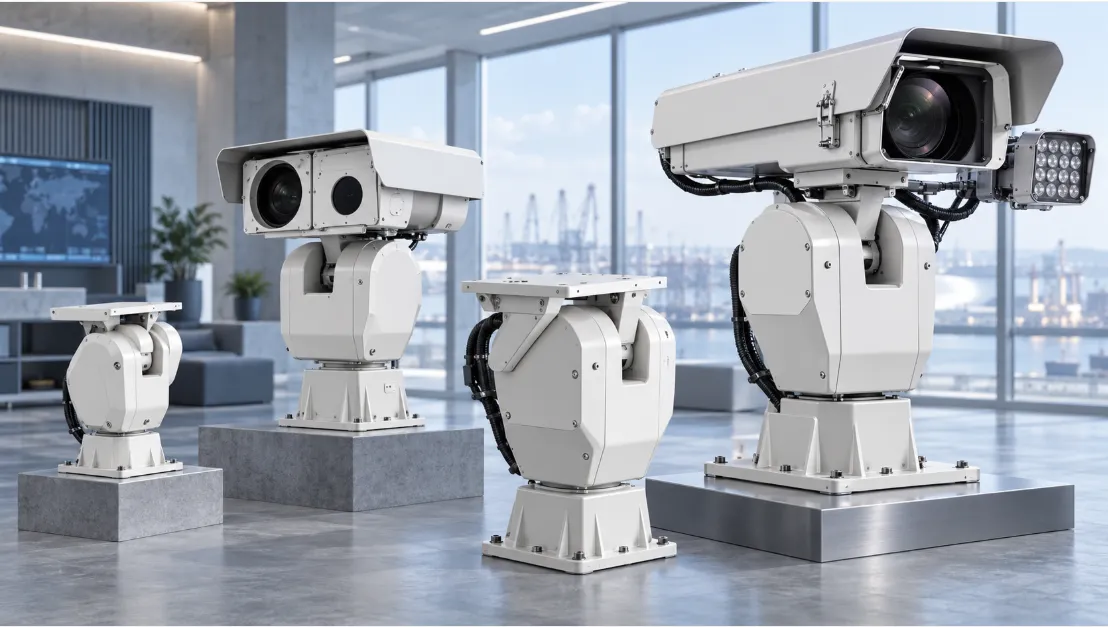
Put twenty-five kilograms into the product line, the position is actually very clear. For a nominal 15kg medium-sized head, the maximum top load is clearly less than 25kg, which is not appropriate for direct use. At this time, the more secure way of thinking is to move up the gear and enter the heavy-duty tripod head of the 50kg class, leaving room for the rated load. Another easily overlooked feature of the heavy-duty PTZ is that its pitch range varies with the load. Take the 50kg model as an example, the pitch range is negative 45 degrees to positive 45 degrees when the load is 50kg, negative 60 degrees to positive 60 degrees when the load is reduced to 40kg, and negative 80 degrees to positive 80 degrees when the load is about 26kg. In other words, the order of 25 kilograms is placed on a 50-kilogram equipment, which can often be exchanged for a pitch capacity close to full stroke.
Load scale from 15kg pan tilt to 100kg pan tilt
To understand a load level, it is best to look at it on a continuous scale. The 15kg 1 gear, that is, 15kg pan tilt, corresponds to a medium-sized pan/tilt, which is used to carry a positioning combination of a single camera, a shield and a lens, with relatively light dead weight. When the load continues to rise, crossing 25kg and 50kg and entering the order of 100kg, which is the heavy application pointed to by 100kg pan tilt, the selection logic is completely different. The higher the level, the more you can't just look at a mass number, allowing torque, moment of inertia, support and foundation load capacity, these factors will become more critical than the weight itself. On the other hand, if the load is actually less than 15kg, the 15kg PTZ is enough, and there is no need to pay extra weight and cost for the excess nominal margin.
Dynamic conditions cannot be ignored
The ability to hold at rest does not mean that it can hold at motion. The maximum load, maximum speed and maximum acceleration usually correspond to different boundary conditions, and cannot be defaulted to be true at the same time. For applications with frequent start and stop, reciprocating scanning, or long-term continuous operation, check the working cycle, continuous heat capacity, and the allowable load inertia of the transmission mechanism. For outdoor and vehicle-mounted scenes, wind load, platform shaking, impact and vibration should be included together. These external forces will not be automatically included in the static load label.
Environment, Installation and Power Supply
After the equipment is selected, the installation and power supply should not be sloppy. The bearing capacity of the installed walls and supports shall meet the safety requirements of four times the total weight of the whole set of equipment. For outdoor use, check the protection level, working temperature, humidity, condensation, salt spray and cable sealing. When continuous horizontal rotation is required, it is also necessary to confirm whether the slip ring or equivalent scheme can bring the power supply, video and data channels. In terms of power supply, the maximum simultaneous power consumption of the camera electronic part, horizontal and tilt motors, lenses, heating, fans, infrared lamps, wipers and other accessories should be included in the calculation. Only based on the single power consumption, it is easy to have problems when the two-axis linkage or accessories are concurrent.



 English
 日本語
日本語 한국어
한국어 français
 Deutsch
 Español
 italiano
 русский
 português
 العربية
 tiếng việt
 ไทย
ไทย čeština
 dansk
dansk Svenska