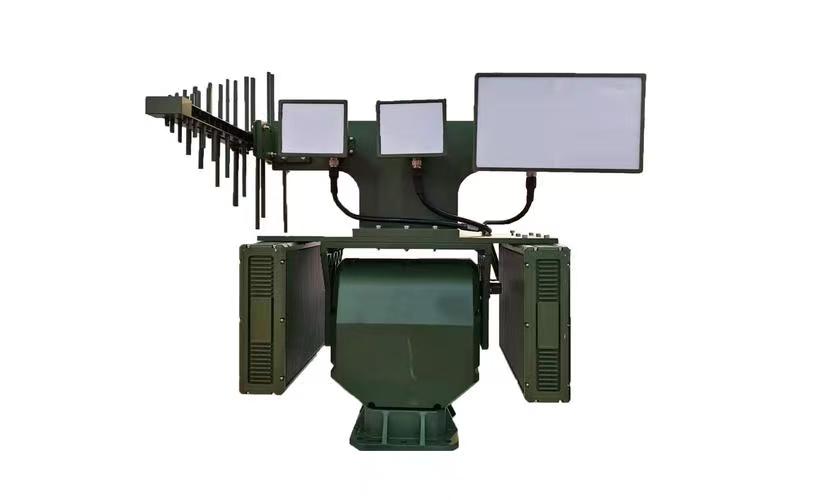
The rotating antenna it is actually an extremely complex mechatronic system. To achieve precise azimuth (horizontal) and pitch (vertical) movements, you must fix a servo motor or stepper motor with a high torque reducer-usually a worm gear.
Why use a worm gear? Because it is small in size and has “self-locking” characteristics. This feature is critical for maintaining pointing accuracy under high wind loads.
The most troublesome challenge is actually: when the antenna rotates continuously at 360 degrees, how to ensure that the signal is continuous and the cable is not knotted?
Drive Core: Stepper Or Servo?
It depends on whether your “muscles” are good enough.
Stepper motor: suitable for low-speed, discrete step scene, win in precision.
Servo motor: It is the first choice for high-speed tracking (such as keeping an eye on the passing drone). Because it has closed-loop feedback, the antenna can correct the position in real time and will never deviate.
Master Space: Azimuth (Az) And Pitch Angle (El)
How does the antenna cover the entire sky?
Azimuth: Responsible for horizontal 360 degree sweep.
Pitch angle: responsible for vertical head-up from the horizon, all the way to the zenith.
By combining these two axes, the antenna can emit a high-gain beam, locking onto any coordinate, whether it is a low-orbit satellite (LEO) or a long-range aircraft.
Unique: Signal Continuity
This is the novice’s most frequently asked question: “The antenna turns so many times, the line will not break?”
The answer lies in two key components:
RF Rotary Joint : Transmission of high-frequency electromagnetic waves. It uses a sophisticated mechanical structure to allow electromagnetic signals to pass through the rotating interface without loss. Even if the antenna speed is extremely high, the insertion loss can be controlled at a very low level.
Electrical slip ring: responsible for power transmission. It relies on the continuous contact between the conductive brush and the rotating ring to transmit power and control signals to the rotating parts. Without it, your motor won’t even turn.
Application Scenarios
.jpg "antenna_rotator(1).jpg")
Understand these, you can understand why they are irreplaceable in modern communication:
Radar scanning: only 360-degree non-stop rotation, aviation and navigation safety can be guaranteed.
Satellite tracking: The satellite is flying in the sky, and the antenna must be calibrated in real time for azimuth and pitch, otherwise the bandwidth will drop instantly.
UAV base station: For long-distance operations, the antenna must “stare” at the UAV so that the beam is most concentrated and the distance can be pulled to the farthest.
Author:Marcus Chen
I am an RF systems engineer with over a decade of experience in mechatronic positioning and satellite communication. My expertise lies in designing high-precision antenna rotators that bridge the gap between complex mechanical motion and seamless signal integrity.



 English
 日本語
日本語 한국어
한국어 français
 Deutsch
 Español
 italiano
 русский
 português
 العربية
 tiếng việt
 ไทย
ไทย čeština
 dansk
dansk Svenska