270 Pan-Tilt-Zoom: What the Pan Range Actually Tells You
Horizontal rotation, tilt motion and lens zoom, these three things together, is what we often call pan tilt and zoom, abbreviated as PTZ. When you see an angle in front of pan-tilt-zoom in the product parameters, such as 270 degrees, this number refers to the range of horizontal direction. It itself does not directly tell you how many degrees the pitch can reach and how close the lens can be pulled, so if you take the 3 function apart, it is not easy to be biased by a number when selecting the type.
3 direction each 1 one thing
Pan is a horizontal rotation around a vertical axis, Tilt is a pitch rotation around a horizontal axis, and Zoom is to change the focal length of the lens, adjust the field of view and image size. A pan-tilt-zoom camera can be a device that integrates camera shooting, rotation and zoom, or a combination of a fixed camera and an external two-dimensional pan-tilt. In this case, zoom should be completed by the camera or lens itself. In other words, the name with pan tilt zoom does not mean that horizontal, pitch and zoom must be performed by the same mechanism, nor does it mean that it must support remote preset or cruise. These capabilities must be confirmed separately.
270 what this number says
The 270 in the parameter table refers to the horizontal rotation range of 270 degrees, which is a limited angle rotation, rather than a continuous rotation that can go on forever. Limited angle rotation allows the cable to be fixed on the mechanism and swing within a certain range with the movement, but the mechanical limit, soft limit, cable margin and minimum bending radius should be checked. Continuous horizontal rotation is supported by the rotating structure itself and the electrical connection across the rotating joint. When the load cable crosses the rotating joint, slip rings or equivalent rotation transmission schemes are usually used.
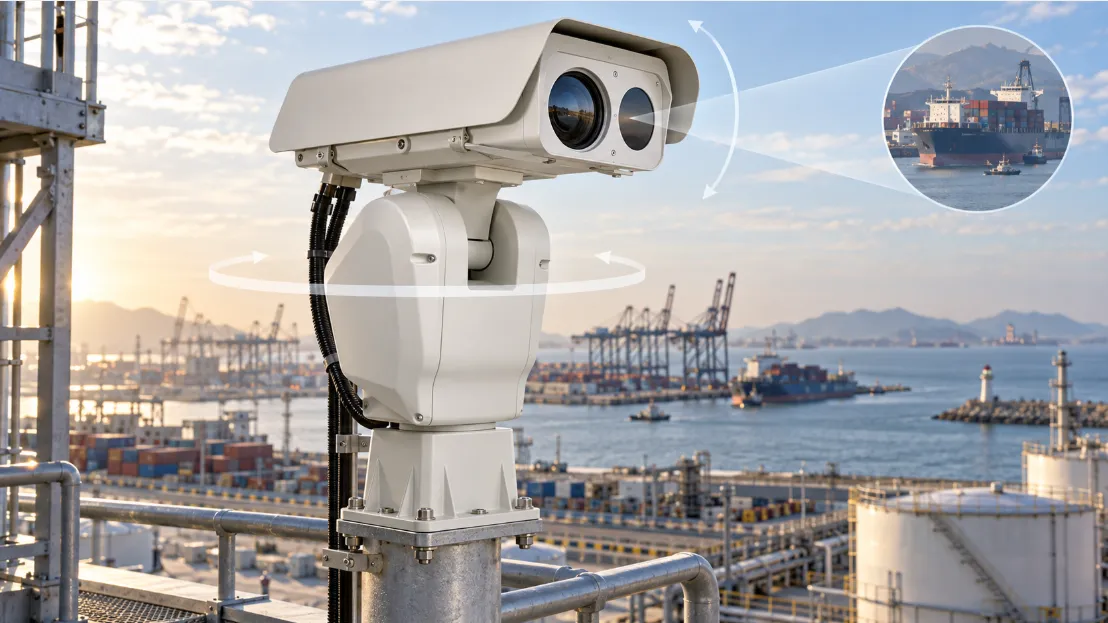
There is an easily overlooked point here. Only 360 degrees are written in the specification, which is not enough to prove that it can rotate continuously indefinitely. It is also necessary to see clear expressions such as continuous and unlimited and check how the cable crosses the rotating surface. On the other hand, a 270-degree pan tilt zoom camera can basically be determined to have limited rotation. A swing margin should be reserved when installing and routing the cable, so as not to let the cable be broken or broken at both ends of the stroke.
Same function, different writing
In the inquiry and comparison of information will find that the English name of such equipment is not uniform. Some people write pan tilt and zoom, some people write pan-tilt-zoom, and some people abbreviate it as ptz pan tilt zoom, or vice versa. When the camera is used, it will be written as pan tilt zoom camera, pan tilt zoom cameras, or pan tilt zoom ptz camera. When talking about the whole system, it is also common to say pan tilt zoom system and pan tilt zoom camera system. Devices used for closed-circuit surveillance are often referred to as pan tilt and zoom cameras, pan tilt and zoom cameras, or more specifically pan tilt and zoom cctv cameras, pan tilt and zoom ptz cctv. Some materials will also be written as ptz pan tilt zoom camera, ptz pan tilt zoom cameras, and even ptz pan tilt & zoom cameras. Most of these differences are written habits, and the structure, protection level or control ability of a device cannot be judged by name alone.
wired or wireless, don't just take it literally
If a device is marked as wired pan tilt zoom camera, its control commands are transmitted through cables, and power supply and video are usually also transmitted through cables. Devices with the word wireless often only control commands to switch to wireless links, which does not mean that video, load power supply or PTZ power supply will also change. Therefore, when comparing pan tilt zoom cameras, the three links of power supply, video and control should be checked separately, and conclusions cannot be drawn based on the words wired and wireless.
Ask these things clearly before selecting the type
Looking at a pan-tilt-zoom device, it is at least necessary to find out: how many degrees is the horizontal rotation range, whether it is a limited angle or an infinite continuous; What is the pitch range? Zoom is completed by the camera or the lens; What are the power supply, communication interface and control protocol? Whether the cable margin and limit meet the requirements of on-site installation during limited rotation. Ask these questions clearly, the number of 270 degrees is of practical significance to you, otherwise it is only a number in the parameter table.



 English
 日本語
日本語 한국어
한국어 français
 Deutsch
 Español
 italiano
 русский
 português
 العربية
 tiếng việt
 ไทย
ไทย čeština
 dansk
dansk Svenska