When many people see pan tilt for the first time, they will default that it means to turn the camera. In fact, it refers to two clear axes of motion. Pan is the horizontal rotation around the vertical axis, and the picture direction rotates left and right in the horizontal direction. tilt is the pitch rotation around the horizontal axis, and the lens pitches up or down. These two actions correspond to different rotation directions, so when talking about pan tilt angle, the range of pan and tilt should be viewed separately. Each has a start point, an end point or a total stroke, and cannot be combined into an angle regardless of direction. The combination of pan and tilt in the same positioning mechanism is often referred to as a two-dimensional pan-tilt, which already covers two degrees of freedom of horizontal positioning and pitch positioning, so from the name alone, pan tilt itself is a matter of two axes, not the third axis.
What does the third axis of a gimbal pan-tilt-roll refer to?
Since pan tilt already occupies two axes, the third axis in 3 axis depends on where the specific equipment is used, which is easy to buy wrong without asking.
On the control rocker, the three-axis rocker usually uses two axes for horizontal and tilt, and the rotation or third axis for zoom, that is to say, the third axis here is zoom, rather than a mechanical rotation direction. In products such as the three-way pan-tilt head, the third axis refers to the roll, which adjusts the horizontal, pitch and roll axes, and is more suitable for static photography that requires axis-by-axis composition and repeated adjustment.
Therefore, the names gimbal pan tilt, gimbal pan tilt roll, gimbal tilt roll pan, pan tilt roll gimbal are not the same thing: some emphasize the presence of 3 axes, while others only emphasize two of them. To judge whether a device is a real three-axis, one cannot look at whether there is 3 or gimbal in the name, but whether the third axis is roll, zoom or other functions. When the words pan and tilt gimbal, pan & tilt gimbal and pan tilt gimbal are mixed together, it is especially necessary to go back to the specification and check the axis number.
What is inside the pan and tilt mechanism?
Make clear the division of the axis and look at the mechanism itself. A set of pan and tilt mechanism that can complete pan tilt rotation cannot be separated from motor, transmission and position feedback. pan tilt motor drives the horizontal or pitch axis to rotate, and pan and tilt motor refers to this kind of motor; pan tilt motor controller is also the pan tilt motor control board, which directly drives the motor and reads the position feedback. it is not at the same level as the keyboard or upper computer software in the operator's hand. Although pan tilt mechanism and pan tilt mechanisms are called singular and plural, they all refer to the same type of horizontal pitching mechanism.
The transmission method directly affects the overall performance of the machine. Worm gears and belts are two different ways. Worm gears and worms cannot be determined to be self-locking only by the form of transmission. Whether they can be driven in reverse depends on the lead angle, friction coefficient and system loss. The horizontal range of motion should also distinguish between limited angle, programmable limited angle and infinite continuous rotation: limited angle allows fixed cables to follow the mechanism, and continuous horizontal rotation requires a rotation transmission scheme such as slip ring, so that power and signal can cross the rotating joint. The specification only states “360°,” which is not enough to prove that it can rotate continuously without limit.
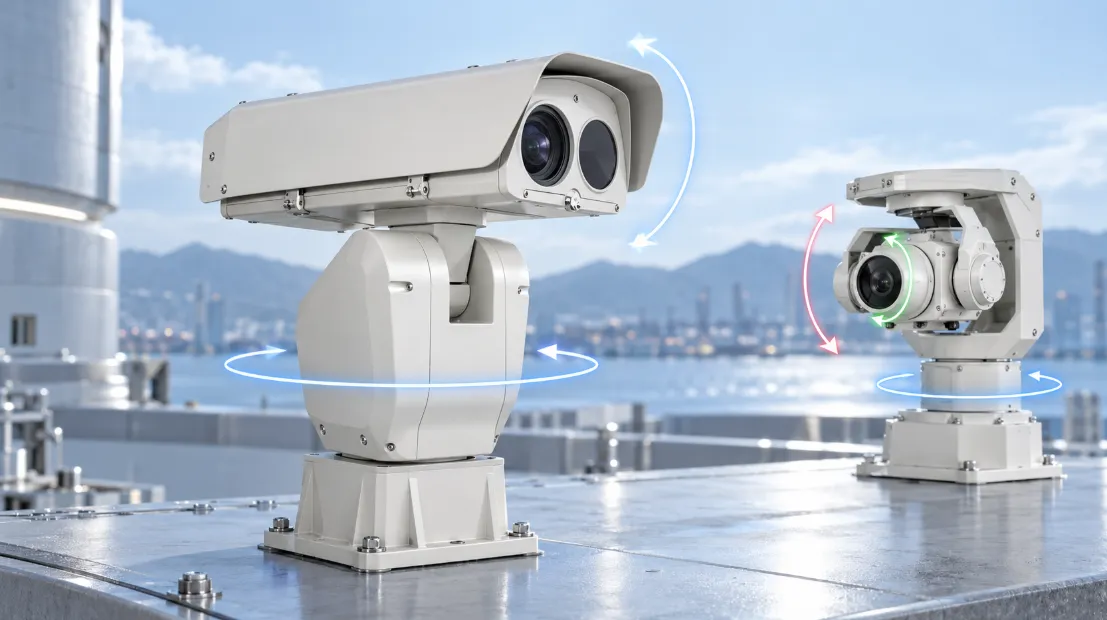
What parameters should be checked when verifying a three-axis gimbal?
When it comes to actual selection, pan and tilt mechanism the key to design and pan tilt mechanism design. We never look at whether the name contains 3 axis or not. What we really need to check is a few real parameters.
The number of axles comes first. The single-axis turntable only solves the horizontal positioning, the two-dimensional pan-tilt head provides the horizontal and pitch positioning at the same time, and the three-axis equipment needs to confirm the third axis above the first two. Then look at the rotation range, whether the horizontal range should be limited or continuous, and the pitch range should look at the upper and lower boundaries separately. Take the BIT-PT409 with a top load of 7 kg as an example, it rotates 360 degrees horizontally and pitches -80 to 20 degrees; the BIT-PT410 with a larger load is continuous 360 degrees and pitches -90 to 40 degrees. The pitching capabilities of the two are very different. The load should also be checked according to the installation method. The top-mounted and side-mounted force arms are different, and the rated values cannot be applied to each other. Speed and accuracy are also seen separately, horizontal speed and pitch speed are recorded separately, and preset position accuracy is evaluated separately.
Only after carefully verifying these points can you determine whether the equipment in front of you is truly a three-axis system or just a two-axis one. The pan tilt rotation meaning also falls to the ground: pan is the horizontal rotation around the vertical axis, tilt is the pitch rotation around the horizontal axis, and the third axis depends on the definition of the equipment itself.
Ultimately, a 3-axis pan-tilt is not a product category you can order just by looking at the name. Yaw in pan tilt yaw can be understood in correspondence with pan in common coordinate conventions for horizontal installation. Whether the third axis is roll or zoom, it must be returned to the specification table. Before buying, it is much more useful to ask the number of shafts, rotation range, load and transmission mode item by item than to remember the English names of 1 strings.



 English
 日本語
日本語 한국어
한국어 français
 Deutsch
 Español
 italiano
 русский
 português
 العربية
 tiếng việt
 ไทย
ไทย čeština
 dansk
dansk Svenska