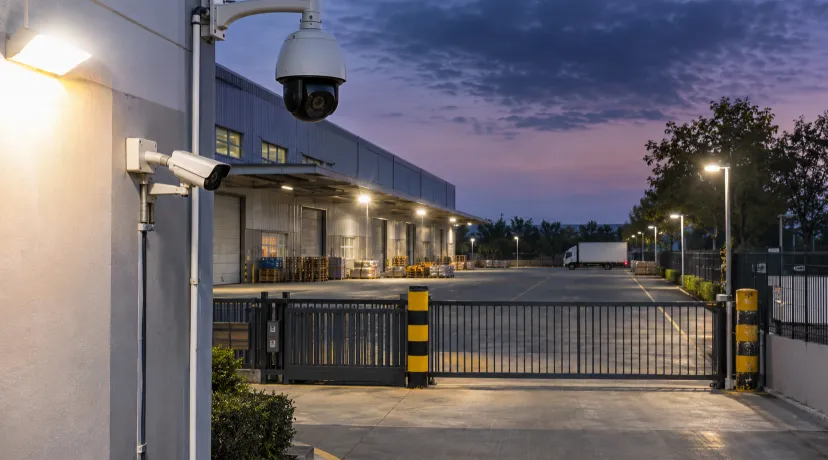
There must be continuous video recording at the warehouse entrance, and the far end of the yard needs to be zoomed in to check it. Priority should be given to using fixed cameras to guard the door, and then using gimbal cameras with optical zoom to check the distance. Even if a single rotatable lens can rotate 360° horizontally, it will only capture the area it is facing at that time. Once the camera turns to follow the car, the doorway may leave the frame. The UK National Protection and Safety Agency (NPSA) site monitoring guidelines also include fixed coverage and gimbal tracking as two tasks that need to be planned separately. NPSA site surveillance guidance
First, look at which point is still recording after the camera turns away
Pan is horizontal rotation, and Tilt is pitch up and down. When selecting a model, separate the horizontal rotation range, pitch range, and lens field of view from the specifications. The first two factors determine where the lens can point, and the field of view determines how wide it can be shot in a certain direction at a time. Use the dot map to check the actual installation height and obstructions, especially near the pole, corners of the wall, and passages that may be blocked by trucks. NPSA site surveillance guidance
| What the site needs | Configuration to consider first | What to verify with a test unit |
|---|
| Operators check several storage areas in turn, and gaps in individual views are acceptable | A single-lens pan-tilt camera with presets | Call up each preset from the proposed mounting point. Check for obstructions and time how long each area stays out of view before the camera returns. |
| The entrance needs continuous recording while a camera follows vehicles into the yard | A fixed camera paired with a pan-tilt camera, or a dual-lens model with a separate fixed wide-angle lens | Play back the entrance footage while the moving lens follows a vehicle. For a dual-lens model, verify that your existing system can record both streams simultaneously. |
| The main gate and loading area are far apart, and both need continuous recording | A dedicated fixed view for each critical area, with a pan-tilt camera added where needed | Stage simultaneous activity at both locations and check whether both recordings capture the required detail. |
Automatic tracking also requires a dual-objective test. For example, have a car drive toward the yard while one person passes through the side door. Play back the two videos to see who the gimbal followed, whether the side door captured anyone, and how long it took for the camera to return to standby after the tracking ended. If no video footage is available for the side door during this period, continuous coverage from an independent perspective is required. NPSA guidance on fixed coverage and auto-tracking
To see details clearly from a distance, first look at the telephoto field of view, then do a night test shot
If the task is to determine whether there are vehicles at the far end of the yard, a wide-angle image may already be sufficient. To read license plates clearly at the same distance, the license plates must occupy enough pixels in the original video. Optical zoom reduces the field of view by changing the focal length, allowing distant targets to occupy a larger portion of the frame. Digital amplification processes the pixels that have already been acquired. When selecting a model, write the maximum working distance and the details to be seen in the same requirement, and at the same time check how much peripheral image is left after the lens is zoomed in. UK police guidance on CCTV recording quality
Take BIT-CCTV's BIT-HDH3020LS and BIT-HDH3020R as examples. Both are 1080p and equipped with a 6–192 mm 32x optical zoom lens. The horizontal field of view angle marked by the manufacturer narrows from 61.2° at the wide-angle end to 2.32° at the telephoto end. The nominal fill distances for the two models are 500 meters (laser fill) and 100 meters (infrared LED fill), respectively. These numbers are suitable for screening test shooting configurations. Whether the license plate can be read clearly or the person can be identified at a specified distance depends on the actual video recording at that point. BIT-CCTV outdoor PTZ camera specifications
During the test shoot, the prototype was placed at the planned installation height and position, allowing the vehicle to pass through the farthest target point at normal speed, retaining the lighting and headlights that would normally be on site, and then the footage was exported from the video recorder. If the license plate of a stationary vehicle can be read clearly but not in the driving picture, check the exposure and fill light and retest with the same route. If the venue allows, the card reading point can also be located at the entrance where the vehicle will already slow down. UK police guidance on CCTV testing and playback
Acceptance using on-site support, power supply, and video recording systems
Try turning it first. Move the lens from the farthest preset position to the nearest point to see if the bracket, eaves, and exit lines will hinder rotation or block the image. Simultaneously turn on night fill light and control the gimbal on the planned power supply line to check for reboots or video interruptions. For models with heaters and wipers, the power supply margin must be checked according to the maximum power consumption given by the manufacturer, and the outdoor joints and incoming line seals must be handled according to the installation instructions.BIT-CCTV outdoor installation and power specifications
Try recording again. Connect the prototype with the network video recorder (NVR) or video management software (VMS) actually used in the project, and verify the rotation, zoom, call preset, and video export item by item. If the procurement requires ONVIF compliance, check the models, firmware versions, and corresponding profiles of both parties in the official database. During on-site acceptance, the footage exported by the video recording system is used to determine whether key points were missed and whether the target details can be clearly seen. ONVIF Conformant Products database UK police guidance on CCTV video export



 English
 日本語
 한국어
 français
 Deutsch
 Español
 italiano
 русский
 português
 العربية
 tiếng việt
 ไทย
 čeština
 dansk
 Svenska