In the event of an abnormal parking on the highway, the staff member can turn the camera on the pole to the incident section, first using the wide angle to see the vehicle ' s relationship to the driveway and then draw closer to the vehicle ' s access. That's the advantage of the cloud charred camera (PTZ). The same space allows for the direction of observation and the visual range to be adjusted to the event. In the split remote monitoring system, the heavy-mounted cloud stand is responsible for horizontal rotation and up and down, and independently installed cameras and lenses are responsible for imaging and focal. The ability to inspect the review is the result of both partial cooperation.Singapore Police Force Video Surveillance System Standard for Buildings, Section 3.3.2 · BIT-CCTV heavy-duty pan-tilt positioner
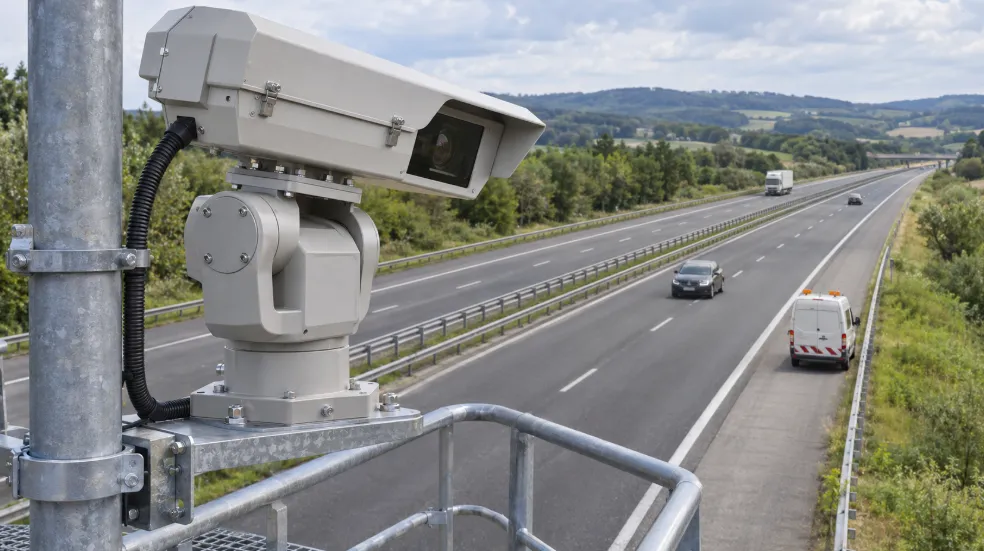
One spot can patrol multiple directions and key areas still need to be recorded on a continuous basis
In the port area, high-level PTZs are able to view the entrance, berthing and stack boundary in order. The project can set a preposition for the direction that is often seen, and when the watchman receives a warning in the assigned area, he or she calls directly to the corresponding location and saves time for manual orientation. The cloud towers that support the cruise can also access multiple points according to the established route. For example, BIT-PT8100, the specifications list a continuous 360° rotation, 200 programmable prepositions and 8 cruise routes each with 10 prepositions. These parameters describe the direction in which clouds can reach and be visited in turn. BIT-PT8100 heavy-duty pan-tilt positioner datasheet
There's a gap between cruises. When the camera turns to the channel, the stack boundary may have left the scene and not re-entered the sight until the next turn. If the gate requires continuous recording of each pass, a fixed camera can be used to secure the gate and PTZ can be charged with the transfer to review. The construction video surveillance standards of the Singapore Police Force also point out that PTZ may not be suitable to cover entry and exit controls due to its diversion from the original control. Singapore Police Force Video Surveillance System Standard for Buildings, Section 3.3.2
Optical focus can see the details of the distance and narrow the horizon.
For the same camera, a short focus end allows more roads to be included in the picture. After cutting to the long focus end, the remote target occupies a larger area on the sensor, reducing the environment on both sides of the picture. When reviewing a vehicle parked on the shoulder, focal points helped to observe the position of the vehicle. It was then pulled back to the wide corner so that the watchman could see again how it related to the adjacent lanes and incoming cars. The BIT-TVC4307W-2132-IP hyperspectral system of BIT-CCTV is an example of a configuration in which the 1080p Visible Light Channel uses 8-320 mm lenses with 40 times the focal length of both ends. BIT-TVC4307W-2132-IP product specifications
40 times only indicates the focus range of the lens. Whether or not the duty officer is able to distinguish the body marking also depends on the stability of the target distance, light, atmospheric visibility and long-focus images. The same angle vibrates, with a much larger picture in the narrow horizon. Therefore, cameras, lenses, shields and scaffolds will be assessed as a load when using a split reloading cloud stand and will be used for the actual installation of a focus video of the inspection. The BIT-PT8100 specifications are marked with 100 kg payloads, which are required for their size and weight. BIT-PT8100 heavy-duty pan-tilt positioner datasheet
Thermal imaging can be searched at night, and then reviewed with visible light
In the case of nightshore patrols, thermal imaging channels can help watchmen first to detect suspicious targets on the surface or shore when there is sufficient heat comparison between the target and the background. When the cloud stands are transferred to the target ' s direction, if there is sufficient lighting or light on the ground, the watchman can switch to the visible light channel and draw closer to the contours and skin marks. Both channels may have a narrower view at the long focus end, and debugging should verify the location of the same target in both images and avoid switching and research. NASA guide to infrared waves and thermal imaging · BIT-CCTV dual-sensor PTZ configuration
It can also carry near-infrared laser patches as needed, allowing compatible cameras to use the photo imaging of the target reflecting back. Thermal imaging receives infrared radiation from the target itself. The problem on the ground is different from the problem solved by the two imaging methods. For example, BIT-S6307W, the product specification lists thermal imaging, visible light and laser recharge modules, and the beam angles of the light patch can be adjusted. The deployment can be done at the physical working distance by switching the wide angles and the long focus to check whether the recharge range covers the area to be seen at the time.NASA guide to infrared waves · BIT-S6307W multisensor PTZ specifications
Three results examined in one warning exercise prior to deployment
1. How long will it take to get a visual? The camera is moved from the usual patrol direction to the warning point, from the time of the call to the preset to the time of the target entry, the focus is stable enough to judge the event. This time is closer to the actual response time than the maximum speed of a single viewer.
2. What can you see from the farthest? Test targets consistent with the mission are placed as far as the planned coverage is concerned and video footage of day and night is viewed. The discovery of vehicles and the identification of body marks are two different results, recorded separately as required by the project.
3. Where's the picture when we turn around? Allow PTZ to keep an eye on one of these directions while returning to the gate or other critical areas. If images were missing during the transition, the region would need to have independent and continuous coverage of the flight space.



 English
 日本語
 한국어
 français
 Deutsch
 Español
 italiano
 русский
 português
 العربية
 tiếng việt
 ไทย
 čeština
 dansk
 Svenska