A head-to-head showdown between an electric gimbal and a hydraulic tripod: Do you want “seamlessly smooth panning” or “uncompromising image quality”?
Torn between a three-axis stabilizer and a hydraulic tripod? Really, you only need to ask yourself one soul‑searching technical question: For this shot, do you want boundless, dynamic camera movements, or razor‑sharp optical precision?
When should you put the machine on the stabilizer? When your shot must "take off" in three-dimensional space, or when you want to take a long shot of immersive sports that is lost and I lose.
So when should you quickly switch back to a tripod? When you’re using a telephoto lens of 85mm or longer for “sniping,” need rock‑steady shots, or rely heavily on the smooth‑to‑follow, instantly stopping, zero‑lag feel of a fluid head’s pure mechanical operation.
Many friends who have not been in the business for a long time always think that these two things can be exchanged. But once you have to take the stabilizer hard anti-telephoto close-up, or carry a heavy tripod to do mobile follow-up, the final film will definitely show a 1 "cheap feeling". The "focal segment threshold" and "T-O-M architecture" we are going to talk about below are specially designed to pull you out of the pit. We must ensure that each of your lenses can accurately match its "original life" base.
New Trend On Set In 2026: AI Vision Is “Forcibly Demolishing” The Moats Of Both Sides
Looking ahead to today in 2026, you’ll find that with the full-scale proliferation of AI tracking technology, the traditional boundary between “static support” and “dynamic stability” has long since been erased.
Today’s motorized camera mounts are far more than just a simple metal block that “stabilizes” your shots. Simply plug it into the base, and it instantly transforms into a fully automatic photography robot. Thanks to today’s next‑generation LiDAR and powerful spatial computing, its automatic composition and subject‑tracking capabilities can even outshine seasoned pros on set.
Of course, the established high-end hydraulic tripods on the other side have been keeping busy as well. They are now all engaging in “intra‑industry competition,” cramming high‑precision digital encoders into their gimbals. What does this mean? The physical camera‑motion path that a photographer once executed purely by muscle memory can now not only be digitally recorded by today’s tripods but also reproduced with pinpoint precision.
The Rule Of T-O-M Equipment Selection: Don't Always Rely On Intuition, Try To Take This 3 Step.
Don't always pat your head or follow your feelings when buying equipment. It is suggested to apply T-O-M (terrain, optics, sports) models to crush your shooting needs:
Site environment (Terrain): If you have to walk on a bumpy road or drill around in a narrow room, the stabilizer is hard currency. However, if the ground is flat and the plane does not move much, the old and honest practical tripod must be right.
Optical focus (Optics): 16mm to 50mm this wide-angle to medium focus interval, is definitely the stabilizer comfortable "home". But once the focal length of the lens soar over 85mm, even a little trembling will be infinitely magnified. At this time, you can only count on the real physical weight of the tripod to suppress the microshock.
Motion Dimension (Motion): Does your lens need to release itself on the X, Y, Z 3 spatial axes (with stabilizers), or do you just plan to get down to a horizontal swing or vertical pitch (this is the best job with a tripod)?
| T - Terrain | Environment | Uneven ground / Narrow interiors | Flat ground / Fixed position |
| O - Optics | Focal Length | 16mm — 50mm (Wide) | 85mm+ (Telephoto) |
| M - Motion | Movement Type | 3-Axis (X, Y, Z) / Tracking | 2-Axis (Pan & Tilt Only) |
Stabilizer: A "Lens Engine" That Can Fly"
The housekeeping skill of the stabilizer is to smooth the hand shake, and by the way, it can also keep you the strong first-person presence. Relying on the three-axis brushless motor inside, it can abruptly shake the ordinary micro-single out of the Hollywood Stannicam (Steadicam) and even the high-rise suspension feeling of the heavy rocker arm.
Z-axis space compensation: unlike the big tripod that is stuck in place, the biggest cool point of the stabilizer is that you can directly walk out of an extremely silky forward and backward propulsion (Dolly Move) lens without having to pave the track.
Cool POV follow-up: when turning or following the shooting, the stabilizer can throw out the unique "roll feeling". When shooting sports themes or action movies, this trick is absolutely amazing for visual speed impact.
Hydraulic Tripod: Physical Precision, Hard Work
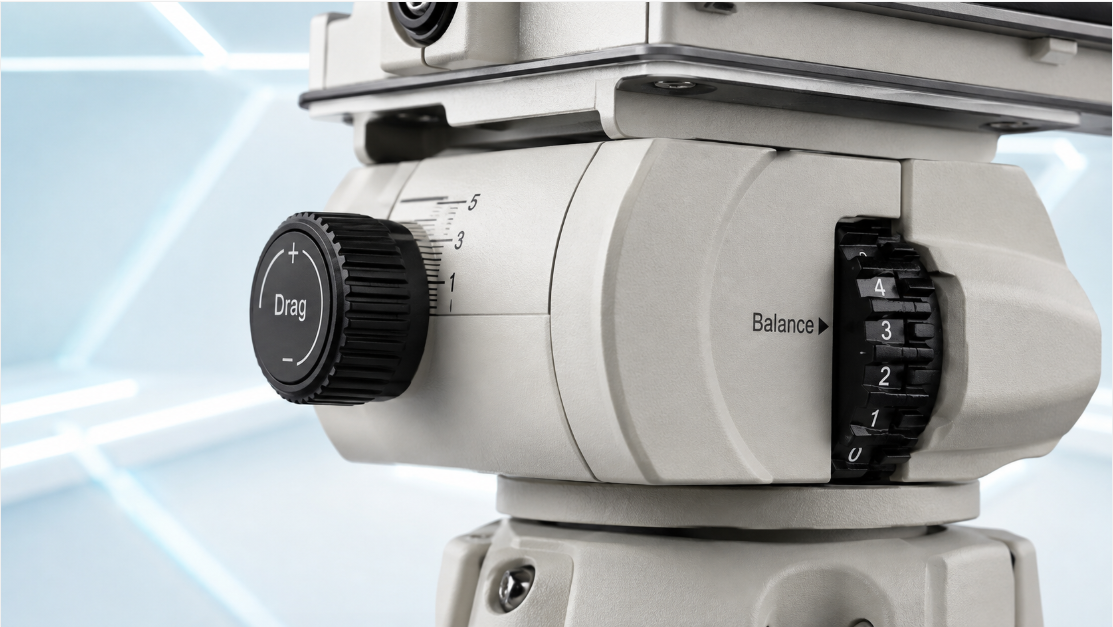
The real hydraulic pan-tilt tripod can give your wrist feedback 1 a "physical damping feeling" that the motor can never simulate ". Professional photographers rely on this "damping resistance" to transport the mirror ". Its natural transition between starting and stopping (called eclosion effect in the industry) is exactly in line with our physiological intuition of seeing things.
Pure zero delay: when you use the stabilizer, your wrist moves, and the motor moves again, with a layer of software algorithm delay in the middle. However, the hydraulic tripod is purely 1:1 physical direct connection, which really achieves "where to hit" and is crisp and neat.
Hard core load-bearing: if you encounter a movie machine with a telephoto cannon and a heavy light-shielding bucket in front of it, the stabilizer's motor will overload and strike every minute. On the tripod side, with a sophisticated dynamic balance system (Counterbalance), you can hold it steady with 1 finger.
Core Pain Point: Never Step On The "Microseismic" Pit Of 85mm Focal Length
We found a dead hole in our actual work: as long as the focal length is 1 than 85mm, even the top stabilizer of the cow has to pull its crotch. The slight high-frequency vibration of the motor and the wind resistance blowing over will produce 1 kind of maddening "high-frequency microtremors". You may not be able to see this kind of jitter at all on the 5-inch monitor behind the machine, but once the material is put on the cinema-level 4K large screen at a later stage, it is simply a disaster scene.
The measured data teach people to be human: under the focal length of 100mm, record it for one minute, and the offset of the picture taken with the tripod is only 0.02. However, if the stabilizer is replaced, even if the photographer has practiced qigong and held his breath, the picture displacement will soar to 1.4.
The old mage's advice: don't be superstitious about high technology when taking close-ups of people's faces, doing interviews or taking product details. The most effective gold medal is to fight the tripod and lock the Yuntai.
Stability Ratings by Focal Length (16mm to 200mm)
| 16mm – 35mm | ★★★★★ | Ultra-Stable | Handheld Gimbal | Motor corrections are virtually invisible. Ideal for dynamic movement. |
| 50mm | ★★★★☆ | High Stability | Handheld Gimbal | Minor micro-corrections; negligible impact on 4K output. |
| 85mm | ★★★☆☆ | The "Trap" Zone | Gimbal (Static) / Monopod | Threshold Point. High-frequency motor hum begins to introduce micro-jitter. |
| 100mm | ★★☆☆☆ | High Risk | Tripod Mandatory | 1.4% Frame Drift. Jitters are invisible on small monitors but ruin cinema-scale footage. |
| 135mm | ★☆☆☆☆ | Critical | Tripod w/ Mech. Lock | Wind resistance and motor resonance cause significant motion artifacts. |
| 200mm | ☆☆☆☆☆ | Unstable | Heavy-Duty Tripod | Any active stabilization (Gimbal) fails. Mechanical locking is the only insurance. |
Avoiding Pit Treasure Book: The Five Low-Level Mistakes Most Easily Burn Money On The Set
The torque of the motor is squeezed dry: novices always like to pile up 1 accessories until they approach the load-bearing limit of the stabilizer. This will not only make the pictures taken follow the "convulsive", but also make the fully charged battery call the police in less than an hour. Listen to the sentence advised that the total weight of the equipment is best controlled within 70% of its nominal maximum load.
The "rebound" of cheap tripods is disgusting: those low-end cheap tripods on the market are full of plastic parts. When you struggle to shake a shot and just stop, the picture will often bounce back in the opposite direction, which can piss you off. Only a professional hydraulic pan-tilt with real oil pressure inside can truly "stop when you say it".
Don't take fast-loading board ecology seriously: before working, be sure to make sure that your stabilizer and tripod use the same set of fast-loading board system (whether it is Manfutu 501 specifications or Akakou). In the race against time set, if in order to get the machine from the tripod
FAQ:
Q: Can the stabilizer be mounted on a tripod and used as a remote pan‑tilt head?
A: Of course it can! This is now a lot of "high-end players" standard work posture. With such a combination of punches, you can hide aside and control the pan-tilt with your mobile phone APP or handle. Not only can we produce the kind of long time-lapse photography that thieves are accurate and can run the same track repeatedly, but also we can easily handle a set of fancy lens scheduling even if we shoot character interviews in individual combat.
Q: Can I take the kind of spherical pan-tilt that takes photos to take videos?
A: Absolutely not! Don't even think about it. The spherical pan-tilt is used for the old mage to shoot static scenery or fight birds. There is no hydraulic damping in it. When you use it to shake the video, it feels like rubbing a clothes board, stiff and abrupt. To shoot a video, you must use a hydraulic pan-tilt with a long handle.
Q: Can the current micro-single body anti-shake (IBIS) replace the stabilizer?
A: I think too much. I really can't replace it. The anti-shake of the fuselage will help you offset the faint tremor of your wrist at most. If you really encounter the physical displacement of walking and trotting, the fuselage will shake and stop eating directly. If you want to shoot that kind of silky mirror, you have to rely on stabilizers.
Q: Why is it still shaking and buzzing when I clearly level the stabilizer?
A: This is usually because your "parameters are tuned". If the strength (Stiffness) of the motor is set too strong and the camera you hang on top is relatively light, the gimbal will produce this self-excited oscillation. Open the mobile phone APP and run it 1 times of "automatic calibration (automatic parameter adjustment)". 80% of the time can cure this problem.
Q: Which one do these two take?
A: From the perspective of stability, the tripod is definitely more reliable. It allows you to lock up the picture composition directly, and then you can safely run away to adjust the lights and watch the scenery, which can ensure the absolute continuity of each picture. If you use a stabilizer, you not only have to be nervous all the time, but also take a lot of physical effort. As long as there is a little mistake, you have to remake it. The fault tolerance rate is too low.



 English
 日本語
日本語 한국어
한국어 français
 Deutsch
 Español
 italiano
 русский
 português
 العربية
 tiếng việt
 ไทย
ไทย čeština
 dansk
dansk Svenska