The top-of-the-line pan–tilt–zoom (PTZ) camera for industrial integration delivers uncompromising clarity: standard industrial pan-tilt systems may provide approximately ±0.1° preset accuracy, while specialized long-range configurations can require higher-precision absolute positioning, depending on focal length, target distance and allowable image displacement. RS‑485/IP telemetry must achieve zero latency, and it must be equipped with a self‑locking worm‑gear mechanism capable of withstanding heavy‑duty loads. Conventional commercial ball machines will directly appear in their original form in long-distance monitoring projects. The reason is simple: the internal motor simply doesn’t generate enough torque to stabilize a high-magnification telephoto lens under dynamic wind loads. This article directly dissects the mechanical vulnerabilities that cause conventional equipment to “lose lock” at distances exceeding 5 kilometers—particularly gear backlash and slip-ring degradation—and reveals the true technical specifications required to select a rugged PTZ remote‑control camera for harsh environments.
The “3-T” Framework For Top-Tier PTZ Camera Selection
Engineers responsible for the security design of critical infrastructure require a set of quantifiable hardware evaluation criteria. The 3-T Framework—Torque, Telemetry, and Tolerance—is a rigorous screening method designed to systematically eliminate substandard pan‑tilt‑zoom systems.
Torque: Tackling The Amplification Effect Of Micro-Vibrations In Long-Range Observations
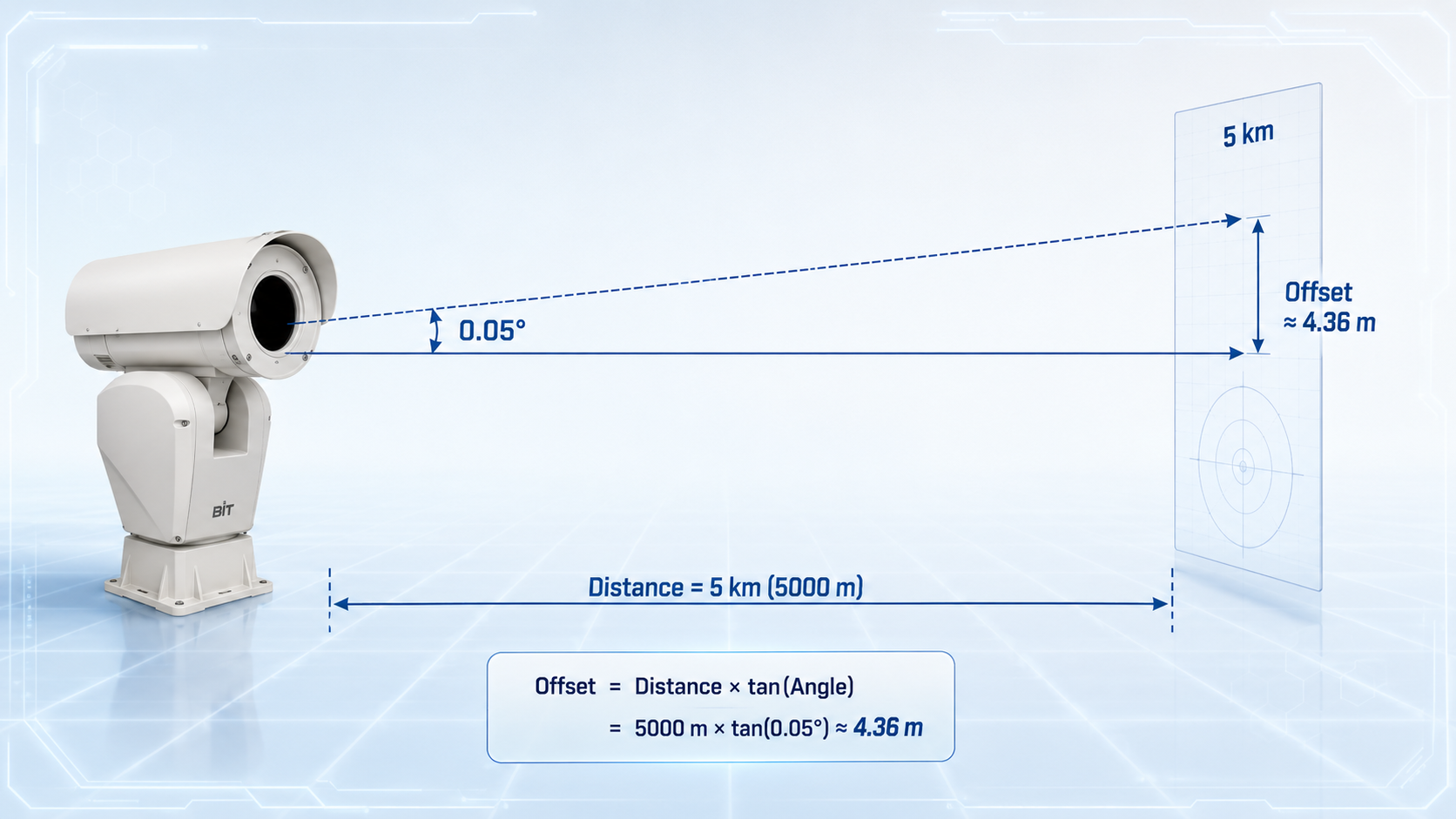
Extremely high holding torque ensures that the target remains locked even at the limits of optical zoom. Even a mere 0.05° of mechanical deformation in the gimbal base will, when tracking a target 5 kilometers away, be magnified into a 10-meter‑wide visual blind spot in the image. Belt-driven motors inherently suffer from slight slippage or elongation over prolonged use, rendering them useless in precision border‑security and maritime‑surveillance applications. When writing tenders, industrial integrators must use heavy-duty models with worm and turbine drives. This type of gear assembly features built-in mechanical self-locking, ensuring that the lens remains firmly locked onto its target even in winds of Force 8.
Telemetry: Completely Eliminates Latency In Ptz Control Systems
In live monitoring, control latency can severely compromise tracking efficiency. When the operator pushes down on the joystick, any delay exceeding 50 milliseconds will trigger excessive control compensation, resulting in shaky footage. High-performance devices will directly execute Pelco-D or ONVIF Profile S commands in real time on the motor drive board, leveraging optimized edge AI computing power. Combined with stepless speed control that ranges from an ultra‑slow crawl of 0.01°/s to a high‑speed dash of 100°/s, the operator can capture fast‑paced car chases or perform wide‑area, low‑speed pans without any frame drops or stutters.
Tolerance: Absolute-Value Encoder And Environmental Sealing
The absolute value encoder completely eliminated the mechanical zero calibration after the power-off restart. The conventional ptz pan tilt zoom camera will lose its spatial coordinates as long as there is a power failure in the. When restarting, it must foolishly turn a full circle to touch the limit switch to reset the positioning. In high-security areas, such calibration blind periods are critical vulnerabilities. The absolute value encoder can lock the accurate X/Y coordinate memory in real time. In systems from specialized manufacturers like BIT‑CCTV, the equipment is housed in IP68‑rated, nitrogen‑filled sealed enclosures, completely eliminating internal lens fogging and ensuring that the encoder and sensors continue to operate reliably even under thermal shock and in coastal salt‑mist environments.
The Hidden Pitfalls In PTZ System Integration
Technology procurement is particularly easy to be biased by fancy software functions, but ignores the mechanical life. Under heavy-load conditions, mechanical degradation of internal components is invariably the leading cause of premature system failure.
The Slip-Ring Burnout Trap Under Heavy-Load Conditions
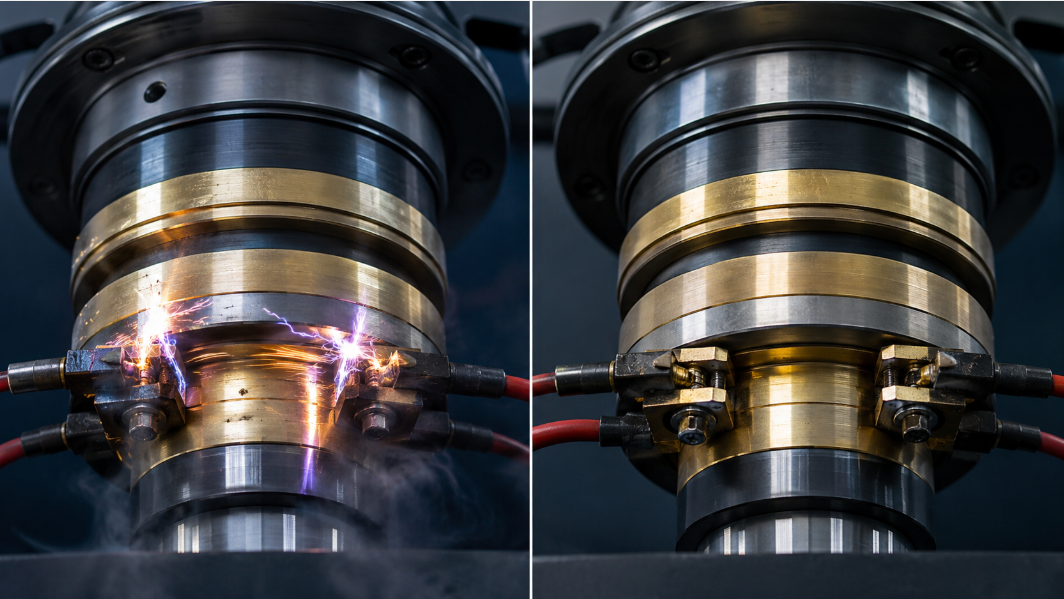
To achieve 360-degree continuous horizontal rotation without the internal cables messing together, it is necessary to rely on conductive slip rings to transmit power and video data. Many cheap slip rings use ordinary brass contacts. Once an external high-power infrared lamp or thermal imaging sensor is powered, the brass will quickly oxidize. Oxidation directly causes the contact resistance to surge, eventually melting even the housing and burning out the gimbal on the spot. Reliable industrial projects must mandatorily employ military-grade “gold-on-gold” contact slip rings. This specialized slip ring can reliably handle continuous high currents while ensuring zero attenuation of 4K video signals.
Gear Backlash Backlash Under Extreme Optical Zoom
Gear backlash is the culprit that destroys the accuracy of the preset position. Backlash refers to the physical clearance between meshing gears. When the gimbal receives a stop command, poor gear engagement causes the device’s housing to physically rebound or drift by several millimeters. Under the optical zoom of 50 times or even 80 times, this micro-level mechanical drift can directly throw the target out of the picture. Precision machined aluminum bronze gears can squeeze the gap to almost zero. The integrator must request the test report from the manufacturer and rigorously ensure compliance with the stringent requirement that the preset‑position repeatability remains within ±0.01° after 100,000 cycles.
Field Measured Data: BIT-CCTV Wind Load And Accuracy Benchmark
Laboratory data to the harsh high-altitude atmospheric environment basically have to be folded in half. We directly mounted a standard industrial‑grade PTZ camera into a controlled high‑speed wind tunnel to rigorously test its ability to lock onto and track a target.
| Wind Speed (Knots) | Belt-Drive PTZ Deflection (°) | BIT-CCTV Worm-Gear Deflection (°) | Visual Target Shift at 3km (Meters) |
| 10 | 0.030° | < 0.002° | Belt: 1.57m | Worm: 0.10m |
| 25 | 0.150° (Visible Drift) | < 0.003° | Belt: 7.85m | Worm: 0.16m |
| 40 | 0.350° (Severe Drift) | < 0.010° | Belt: 18.33m | Worm: < 0.52m |
| 45 | > 0.500° (Tracking Failed) | 0.005° (Absolute Lock) | Belt: > 26.18m | Worm: 0.26m |
The hard data that ran out stripped the structural rigidity of the underpants. The old model of belt drive began to show visible axial drift under the continuous wind speed of only 25 knots. However, the heavy-duty turbine worm mechanism still keeps its absolute position locked when it carries 45 knots of wind. Data acquired from the built-in absolute encoder indicate that the maximum coordinate deviation of the preset position is only 0.005°. This proves one thing: if you want to preserve the absolute integrity of long‑distance visual data, mechanical self‑locking is absolutely indispensable.
FAQ
What is the maximum effective observation distance of a ptz remote control camera?
The maximum shooting distance depends entirely on the lens’s focal length and the degree of atmospheric interference. If the base can completely eliminate vibrations, a specialized long‑range gimbal equipped with an 800‑mm lens and thermal imaging would be capable of directly detecting vehicle‑sized targets at a distance of 10 kilometers.
How exactly does gear backlash destroy pan-tilt-zoom accuracy?
Gap is the physical gap between mechanical gears. When the motor brakes, this gap will cause slight shaking of the head of the gimbal. As long as the zoom is dialed up sufficiently, even this slight shake is enough to cause the focus to completely lose track of the target.
Why does industrial PTZ have to be on absolute value encoder?
The absolute value encoder can give a unique digital code to each physical position of the camera. In case the system is powered off, the pan-tilt can immediately know where its face is facing when it is powered on again, and there is no need to turn around slowly to make mechanical reset.
Can standard pan-tilt-zoom cameras directly mount an external thermal imaging lens?
Absolutely not. The external thermal imaging lens and heavy infrared lamp fill light array will completely change the center of gravity of the equipment and directly support the dynamic load limit of ordinary consumer motors. Gimbals equipped with dual heavy‑load sensors must be fitted with custom‑specification high‑torque motors; otherwise, they will burn out in minutes.
How does the control delay during PTZ joystick tracking come about?
Either the network data packet card, or the decoding board inside the camera is too weak to parse RS485/Pelco-D instructions. The high-end system directly carries out calculation force processing at the local edge end, instantly digesting telemetry data, so that the joystick can really point where to hit.
What is the principle of mechanical self-locking in ptz pan tilt zoom?
Mechanical self-locking is a unique physical dead‑lock effect inherent to worm‑gear drives: external forces—such as strong winds or deliberate manual pushing—cannot cause the gears to reverse. It ensures that once the motor is braked, the gimbal is immediately welded to death in place without consuming any additional power to maintain this posture.



 English
 日本語
日本語 한국어
한국어 français
 Deutsch
 Español
 italiano
 русский
 português
 العربية
 tiếng việt
 ไทย
ไทย čeština
 dansk
dansk Svenska