To build a truly reliable commercial surveillance camera system, it is not only necessary to accurately calculate the heat dissipation of the internal edge AI processor and verify the voltage limit of long-distance PoE power supply, but also to carefully select those NEMA protection grade enclosures that can withstand active corrosion. If you only focus on the basic IP67 dustproof and waterproof level in the industrial scene, it is tantamount to digging a hole for yourself-high maintenance costs and premature hardware scrapping will definitely come to you.
Next, we will dismantle the hard core to ensure the “zero downtime” of the system, teach you how to avoid the invisible power supply trap that allows the equipment to “lie down” winter, and take you to have an in-depth understanding of the structural configuration tailored for high-risk environments.
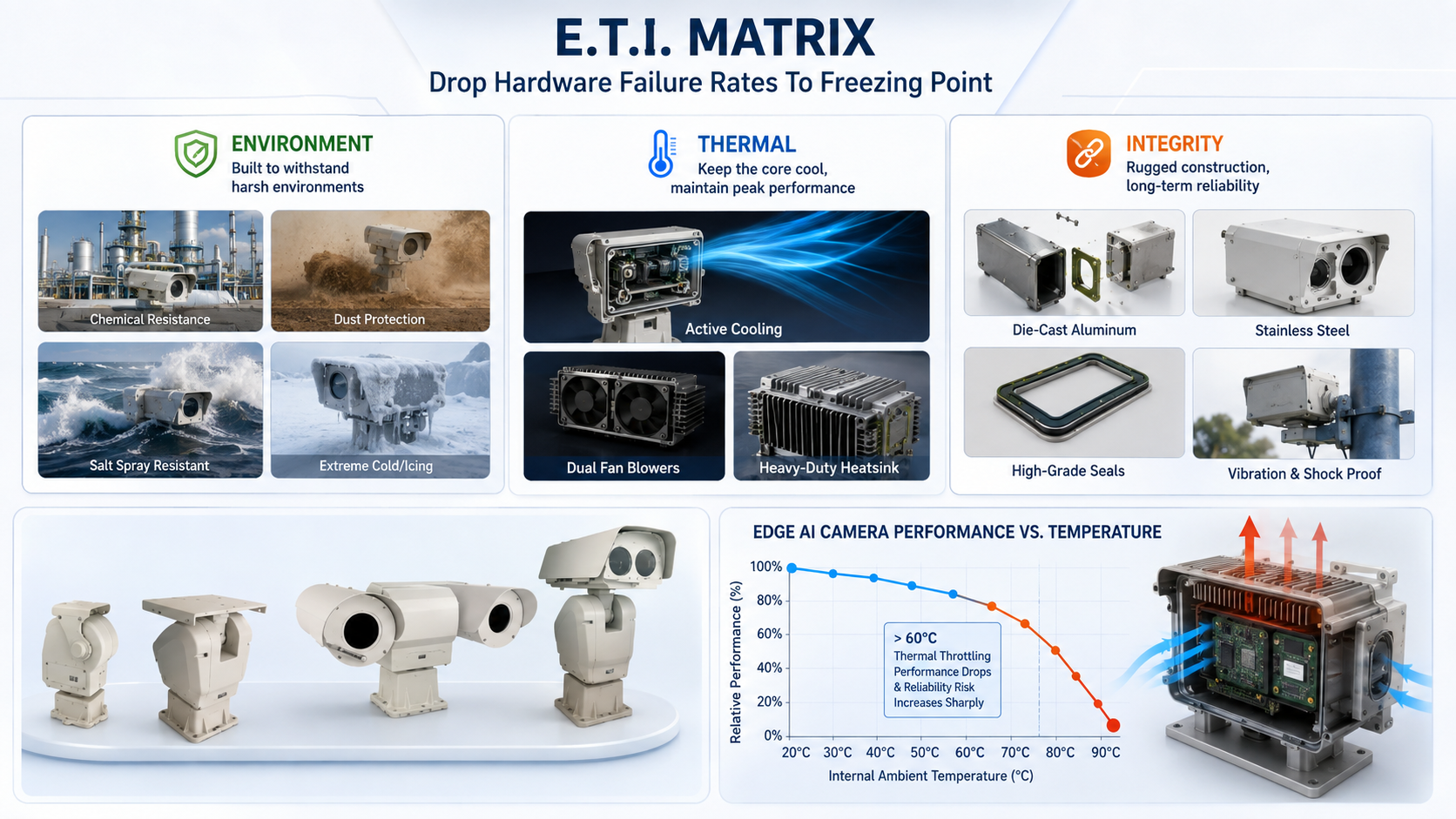
E.T. I. Matrix: Drop Hardware Failure Rates To Freezing Point
Both system integrators and procurement engineers often use the E.T. I matrix as a ruler when matching industrial-grade housings for cameras. With this effective evaluation framework, B2B hardware deployment is no longer a “blind box”, but really evidence-based.
Environmental Considerations: Don’t Confuse NEMA 4X With Normal IP Rating
In complex industrial sites, equipment must withstand chemical erosion and flying dust, NEMA 4X certification is almost standard. The common IP66 or IP67 standards on the market, at best, only measure the ability to prevent the penetration of clear water, without considering salt spray and industrial solvents at all, not to mention the fatal damage to the structure caused by external icing. In order to prevent the shell seal ring from aging in advance under the continuous destruction of chemicals or strong ultraviolet rays, die-cast aluminum or heavy stainless steel must be recognized when selecting the type.
Thermal Management: Taming The “Core” Fire Of Edge AI Processors
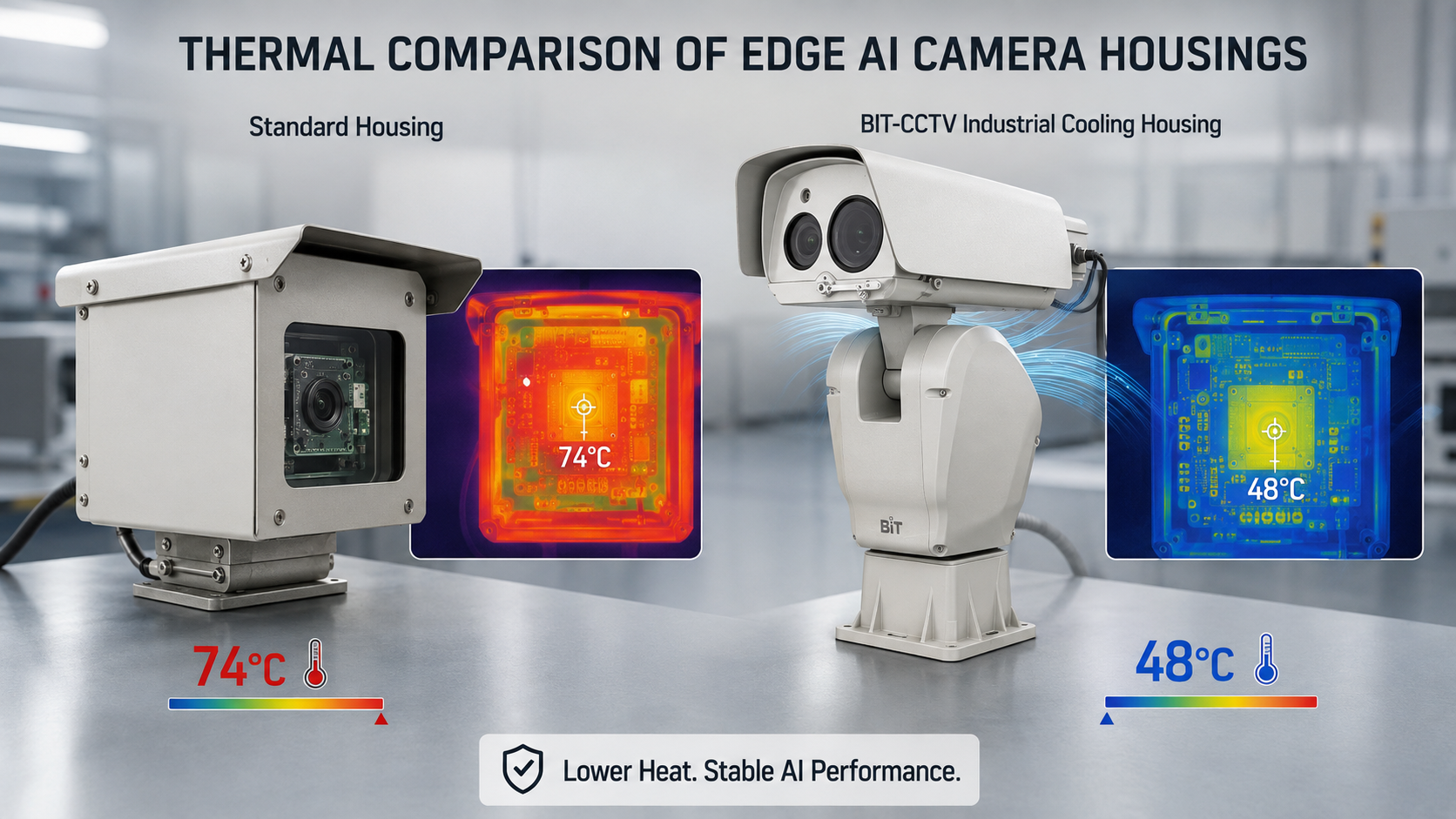
Today’s edge AI cameras generate so much heat that ordinary shells simply cannot dissipate. Once the internal ambient temperature exceeds 60°C, the processor responsible for running the deep learning algorithm will immediately reduce the frequency and protect itself. This requires “hard work”-such as an active cooling cycle system, dual fan blowers, or large heavy cooling fins. A set of excellent heat dissipation design of the shell, can quickly remove the heat from the camera body, the performance of the silicon components to keep the bottom line, to prevent thermal decay.
System Integration: Beware Of The “Reef” Of Poe Long-Distance Pressure Drop”
The voltage drop caused by long-distance network transmission is simply the “invisible killer” of the winter shell heater “. Many integrators are used to calculating PoE power supply budget directly according to 60W or 90W at the switch end, but they forget to calculate the resistance loss of the 80 m cable itself. The result is often: the camera itself has low power consumption and is turned on smoothly; but the 24V heating module directly strikes because of the pressure drop. When the cold wave came, the camera instantly fogged and could not shoot anything clearly. Therefore, it is important to account for the actual available power of the equipment terminal. As long as the camera housing with heating function is more than 50 meters away from the switch, industrial grade PoE relay power supply must be added honestly.
Top Choice For High-Risk Scenes
Industrial sites have extremely high requirements for the structural strength of equipment, and ordinary extruded shells from other manufacturers are simply not enough to look at. Engineers must turn their attention to highly customized enclosures designed to withstand physical impacts, explosive gases, and severe corrosion.
Explosion-Proof Configuration
In refineries, chemical plants, and grain elevators, it is clearly stipulated that equipment that has passed the dual certification of ATEX and IECEx must be used. You should know that ordinary camera housings are very prone to static electricity and internal electric sparks. Once combustible dust or gas in the air is ignited, the consequences will be disastrous. Here, explosion-proof shells are the only solution. Their original design is to cover any internal explosion in the shell to the death and never break it. Big source manufacturers like BIT-CCTV are very good at turning these “heavy armor” with carbon steel and special alloys, thus ensuring that the equipment can perfectly meet the standards in any high-risk environment around the world.
Technical Parameter Comparison: Camera Housing Types
| Housing Type | Material | Tensile Strength (Approx.) | Applicable Certifications (ATEX/NEMA) | Typical Industrial Applications |
| Standard Aluminum Housing | Extruded Aluminum Alloy (e.g., 6061/6063) | ~150 - 250 MPa | NEMA 4, IP66/IP67 | Commercial buildings, standard street surveillance, general indoor/outdoor security |
| Marine Grade 316L Housing | 316L Stainless Steel | ~485 MPa | NEMA 4X (Highly Anti-Corrosive), IP68 | Seaports, offshore wind farms, coastal surveillance, marine vessels |
| Explosion-Proof Housing | Heavy-duty Carbon Steel, Thick 316L, or Special Alloys | > 500 MPa (Designed for internal explosion containment) | ATEX, IECEx, NEMA 7 (Hazardous Gas), NEMA 9 (Hazardous Dust) | Oil & gas refineries, chemical processing plants, grain elevators, mining operations |
The Nemesis Of The Ocean And Highly Corrosive Environments
In environments filled with high concentrations of salt water or heavy industrial pollution, ordinary aluminum brackets will corrode after only half a year. For seaport terminals, coastal monitoring networks and chemical treatment plants, 316L stainless steel shells are the only way out. Due to the addition of molybdenum, 316L stainless steel can extremely effectively resist chloride-induced pitting and crevice corrosion. Installing the internal PTZ or fixed bolt into this special housing can effectively prevent the complete paralysis of the entire system and fundamentally save integrators a large amount of later equipment replacement costs.
FAQs
What is the limit distance for powering a housing with heating function with PoE?
Following the standard IEEE 802.3bt protocol, power supply efficiency drops off dramatically once it exceeds 100 meters. If your enclosure is equipped with a high power heater, considering the pressure drop problem, as long as the cable exceeds 70 meters, the heater will most likely not be able to be carried. At this time, either a dedicated industrial-grade PoE extender is installed, or a 24VAC independent power supply is connected directly to the device.
Is it necessary to install wipers on the outdoor camera housing?
If the equipment is installed in a mining area, seaport or highway where dust and particulate matter are flying everywhere, integrated wipers are absolutely essential. It scrapes away crystallized salt, mud, and industrial oil at any time, keeping security operators with a clear view at all times, which is much better than having to pay a human to climb a pole to clean the lens every now and then.
How to scientifically calculate the thermal load of a camera housing?
Do a simple addition: add together the maximum power consumption of the network camera itself and the lens motor, and convert it to BTU per hour. Take this total value and compare it with the maximum heat dissipation rating given by the shell manufacturer. As long as the heat generation does not exceed the standard, the internal temperature can be firmly controlled within the red line of safe operation of the camera.
Can PTZ cameras fit into protective housings?
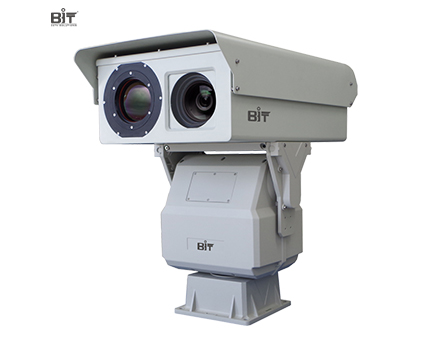
No problem at all. There are now many manufacturers that have customized ball or barrel-shaped housings specifically for movement modules and built-in gimbal zoom modules. Not only do the transparent ball covers in the lower half of these shells achieve optical-grade distortion-free, but they also integrate a special electric bracket inside, which perfectly adapts to 360-degree panoramic rotation without dead angles.
Also stainless steel housing, what is the difference between 304 and 316L?
The core difference is that “molybdenum” is added to 316L. Because of this element, 316L leaves ordinary 304 far behind in its ability to resist local corrosion and chloride erosion. In a word: As long as it is a maritime, coastal or heavy chemical project, it is right to identify 316L.



 English
 日本語
日本語 한국어
한국어 français
 Deutsch
 Español
 italiano
 русский
 português
 العربية
 tiếng việt
 ไทย
ไทย čeština
 dansk
dansk Svenska