Selecting the top security pan tilt camera for total home safety requires discarding consumer-grade plastic domes and upgrading to industrial multi-sensor pan tilt positioners capable of radar-linked tracking and thermal imaging. Large-scale residential properties—including private estates, gated communities, and sprawling villas—demand heavy-duty mechanisms like worm-gear drives to guarantee continuous perimeter defense without mechanical failure. Standard retail cameras suffer from structural fatigue during 24/7 patrol cycles and leave massive blind spots across expansive acreage. You are about to discover how elite security engineers eliminate patrol dead zones, avoid the fatal mechanical flaws in conventional CCTV layouts, and apply a specialized three-tier architectural framework to secure ultra-high-net-worth properties against sophisticated intrusions.
Redefining “Total Home Safety” For Large-Scale Properties
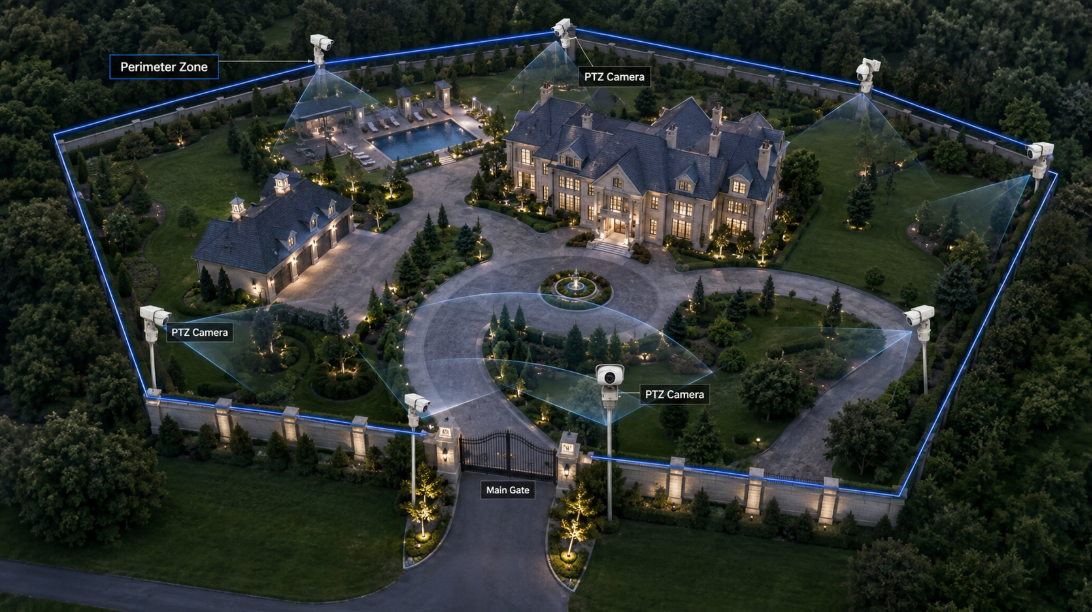
Protecting a fifty-acre private estate presents complex logistical challenges that render standard residential cameras entirely useless. High-end property managers and CCTV system integrators evaluate site security based on perimeter depth, early warning capabilities, and hardware endurance in harsh environments. A genuine security pan tilt camera designed for these environments operates as a ruggedized, continuously rotating optical platform carrying multiple heavy sensors. Industrial-grade solutions deploy dual-vision payloads combining visible light lenses with thermal imaging to cut through dense foliage, heavy rain, and absolute darkness.
The Pitfall Guide: Exposing The Patrol “Dead Zone”
Relying exclusively on a standalone pan tilt camera in continuous patrol mode guarantees fatal security blind spots. Intruders simply monitor the mechanical sweep of the camera and breach the perimeter the exact moment the lens faces the opposite direction. Inexperienced installers frequently deploy high-speed domes on automatic preset tours, falsely believing this provides 360-degree coverage. Active threats exploit these predictable mechanical cycles to slip through unrecorded.
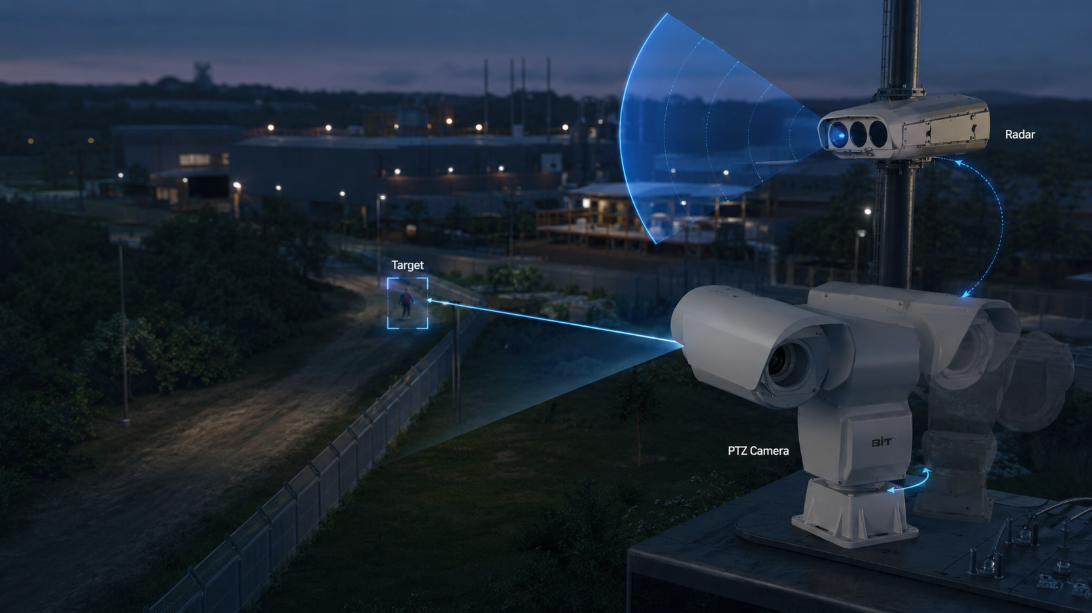
Eliminating these dead zones requires linking fixed wide-angle sensors or ground-based radar directly to the pan tilt unit. Radar detects movement instantly up to hundreds of meters away and outputs absolute coordinate data via ONVIF protocols. The linked pan tilt camera immediately abandons its standard patrol route and slews exactly to the target’s azimuth and elevation. Security architects specify equipment like BIT-CCTV heavy-duty positioners to handle these sudden, high-torque directional changes without burning out the internal motors.
The 3-Tier Perimeter Defense Pyramid
Security professionals structure large-scale residential protection using a strict 3-Tier Perimeter Defense Pyramid to ensure zero false negatives. Relying on a single line of defense guarantees eventual perimeter breaches.
Tier 1: Wide-Area Pre-Warning (Radar & Thermal)
The outermost perimeter relies entirely on invisible, weather-proof detection mechanisms. Thermal sensors and short-range ground radar identify human heat signatures or mass movement miles before the target breaches the physical boundary line.
Tier 2: Uninterrupted Active Tracking (Continuous Rotation)
Once Tier 1 triggers an alert, the system activates the heavy-duty pan tilt camera for active tracking. High-torque pan rotators equipped with long-range laser night vision maintain visual lock on the target. The mechanical drive must support infinite 360-degree continuous rotation to track fast-moving vehicles or individuals maneuvering across the estate grounds.
Tier 3: Core AI Verification (NVR Edge AI)
The final tier processes the video feed through central VMS or NVR analytics to filter out wildlife or blowing debris. Sophisticated AI cross-references the target’s behavioral patterns and optical data to dispatch real-time alerts to the central security monitoring station or on-site guard personnel.
| Tier | Specific Hardware Required | Detection Range | Primary Function |
| Tier 1: Wide-Area Pre-Warning | Thermal sensors and short-range ground radar | Miles before the target breaches the physical boundary line | Provide invisible, weather-proof early warning by identifying human heat signatures or mass movement. |
| Tier 2: Uninterrupted Active Tracking | Heavy-duty pan tilt camera, high-torque pan rotators (infinite 360-degree rotation), and long-range laser night vision | Estate grounds | Maintain continuous visual lock and actively track fast-moving vehicles or maneuvering individuals. |
| Tier 3: Core AI Verification | Central VMS (Video Management System) or NVR (Network Video Recorder) with edge AI | Core perimeter / Video feed processing | Filter out wildlife or debris, cross-reference behavioral and optical data, and dispatch real-time alerts to security. |
Mechanical Durability: Worm-Gear Drives Vs. Micro-Steppers
Mechanical degradation causes the vast majority of camera failures in outdoor perimeter deployments. Retail-grade PTZ units utilize nylon belts and micro-stepper motors that warp under continuous lateral wind loads and severe temperature fluctuations. Industrial pan tilt positioners manufactured by BIT-CCTV employ CNC-machined worm-gear or servo direct drives capable of supporting payloads from 3.5kg up to 120kg. Upgrading to cast-aluminum, heavy-duty housings guarantees uninterrupted azimuthal rotation even during severe weather events.
Payload capacity dictates the types of optical equipment the integration team can deploy. Heavy-duty pan tilt units easily carry massive long-range zoom lenses, heavy laser illuminators, and independent thermal camera enclosures simultaneously. Deploying separate enclosures on a unified pan tilt head simplifies maintenance and allows technicians to replace a single optical component without discarding the entire positioning unit.
Case Study: Defeating Extreme Coastal Weather On A 20-Acre Estate
Saltwater corrosion and sustained 40-knot coastal winds dismantle standard outdoor surveillance equipment within months. An integration firm recently overhauled a 20-acre private coastal property utilizing BIT-CCTV heavy-duty pan tilt positioners coated with marine-grade anti-corrosion treatments. The site originally suffered a 45% hardware failure rate using commercial-grade PTZ domes due to wind-induced motor stalling and internal salt buildup.
Replacing the failing hardware with 60kg load-capacity worm-gear driven pan tilt units eliminated wind stall entirely. The engineering team integrated long-range laser night vision arrays directly onto the new positioners. The upgraded system achieved a 0% false-negative intrusion rate and required zero mechanical maintenance during an intense six-month winter evaluation period.
“Deploying consumer PTZ cameras on a coastal cliff is a fast track to mechanical failure. Integrating high-torque worm-gear positioners was the only way we could maintain active tracking in 40-knot winds without the motors burning out.” – Lead Integration Engineer, Coastal Security Solutions.
Installation Directives For Integrators
Mounting stability directly impacts the performance of high-magnification optical zoom. Heavy vibrations from weak mounting structures cause severe image distortion when a pan tilt camera zooms in on targets hundreds of meters away. Integrators specify thick-gauge steel or aluminum U-shape and L-shape camera mounting brackets designed specifically for high-load industrial use. Securing these brackets directly to structural concrete or deep-set steel poles prevents wind-shear oscillation and ensures crystal-clear long-range identification.
Power distribution across vast acreage demands strict adherence to voltage drop calculations. Heavy-duty positioners equipped with internal heaters and laser illuminators draw significant wattage, exceeding the capabilities of standard PoE+ switches. Technicians install dedicated 36VDC or 48VDC industrial power supplies at the mounting pole to guarantee the camera receives peak current during freezing conditions when mechanical resistance is highest.
FAQs
Q: How does a security pan tilt camera integrate with perimeter radar?
System integrators connect ground radar and the pan tilt camera via ONVIF protocols through a central VMS. The radar detects movement and instantly sends exact GPS or azimuth coordinates to the camera, forcing it to immediately focus on the intruder without human intervention.
Q: What is the recommended payload capacity for multi-sensor pan tilt cameras?
Large estates requiring long-range laser night vision and dual-thermal setups need pan tilt positioners with a payload capacity of at least 15kg to 30kg. Extreme applications involving heavy custom enclosures utilize 60kg to 120kg capacity units to prevent motor strain.
Q: Can heavy-duty pan tilt cameras operate in extreme cold?
Industrial-grade pan tilt positioners feature integrated heating modules and utilize specialized low-temperature lubricants. This prevents worm-gear freeze-up and allows the unit to rotate smoothly in temperatures dropping as low as -40°C.
Q: Why do commercial PTZ cameras fail in large estate installations?
Commercial PTZ cameras use plastic gears and small stepper motors that cannot handle continuous 24/7 scanning. Wind resistance against the camera body causes these weak motors to stall and burn out rapidly in open outdoor environments.
Q: How does ONVIF compliance affect pan tilt camera integration?
ONVIF compliance guarantees the pan tilt unit communicates natively with any major Video Management System (VMS) or Network Video Recorder (NVR). It ensures standardized control over mechanical rotation, optical zoom, and analytic data transfers across different equipment brands.
Q: What is the difference between a pan tilt positioner and a standard dome PTZ?
A pan tilt positioner is a standalone heavy-duty mechanical head that carries separate camera housings externally. A standard dome PTZ encloses a small camera and light-duty motors inside a single plastic or thin metal bubble, limiting payload size and overall durability.
Q: How do dual-vision thermal and visible cameras improve night surveillance?
Thermal sensors detect the heat signature of a trespasser through fog, bushes, and total darkness where standard night vision fails. Once detected, the system uses the visible camera lens and laser illumination to capture identifying details like clothing colors or license plates.



 English
 日本語
日本語 한국어
한국어 français
 Deutsch
 Español
 italiano
 русский
 português
 العربية
 tiếng việt
 ไทย
ไทย čeština
 dansk
dansk Svenska